
What to Take Out at Airport Security in Canada: It Depends on Your Lane.
If the rules seem to change between trips, that is because they do. Canadian airports run four different kinds of screening line, and each one asks for something different from your bag and your body. This guide explains all four, and maps which operate at each Toronto Pearson checkpoint.
You took the laptop out in June and were waved through with it in the bag in July. You kept your shoes on at one checkpoint and were asked about them at another. Neither of those is a mistake by anyone involved.
Canadian pre-board screening is not one process. It is four, running side by side at large airports, each with its own divestment rules. The single most useful skill at a checkpoint is reading the signage before you choose a queue. If you also need the packing rules themselves, those live in our guide to the wider carry-on rules on powders, blades and batteries.
What to take out at airport security in Canada depends on the lane. On a regular or CATSA Plus line, your laptop and liquids bag come out. On a CT-equipped line, large electronics and permitted liquids stay in your bag. On a Verified Traveller line you may also keep shoes, belts and light jackets on.
Why the rules seem to change.
Two things are happening at once. CATSA is deploying new scanning technology airport by airport and line by line, which changes what officers need to see separately. And it runs a dedicated programme for travellers who have passed background checks, which changes what those travellers need to remove.
Because both are rolled out by checkpoint rather than by airport, coverage is uneven. Two terminals at the same airport can differ. So can two levels within one terminal, which is precisely the situation at Toronto Pearson.
The consistent part is the signage. CATSA posts it at the front of each checkpoint, stating which services are available and what benefits apply there. Ten seconds spent reading it saves considerably more than ten seconds later.
At a GlanceThe four screening lanes compared.
| Lane | Laptop | Liquids bag | Shoes, belt, light jacket | Who can use it |
|---|---|---|---|---|
| Regular line | Out, flat in a bin | Out, in a bin | Outer jacket off; shoes and belt usually stay on | Everyone |
| CATSA Plus | Out, flat in a bin | Out, in a bin | Same as a regular line | Everyone |
| CT-equipped line | Stays in your bag | Stays in your bag if 100 ml or less per container | Same as a regular line | Everyone, where available |
| Verified Traveller (domestic) | Stays in your bag | Stays in your bag | All stay on, headwear included | NEXUS, Global Entry, military, aircrew, RAIC holders, RCMP and police |
| Verified Traveller (transborder) | Out — not covered by the benefit | Stays in your bag | All stay on, headwear included | As above, on U.S.-bound flights |
The fifth row is the one worth reading twice, and it is covered below.
The regular line.
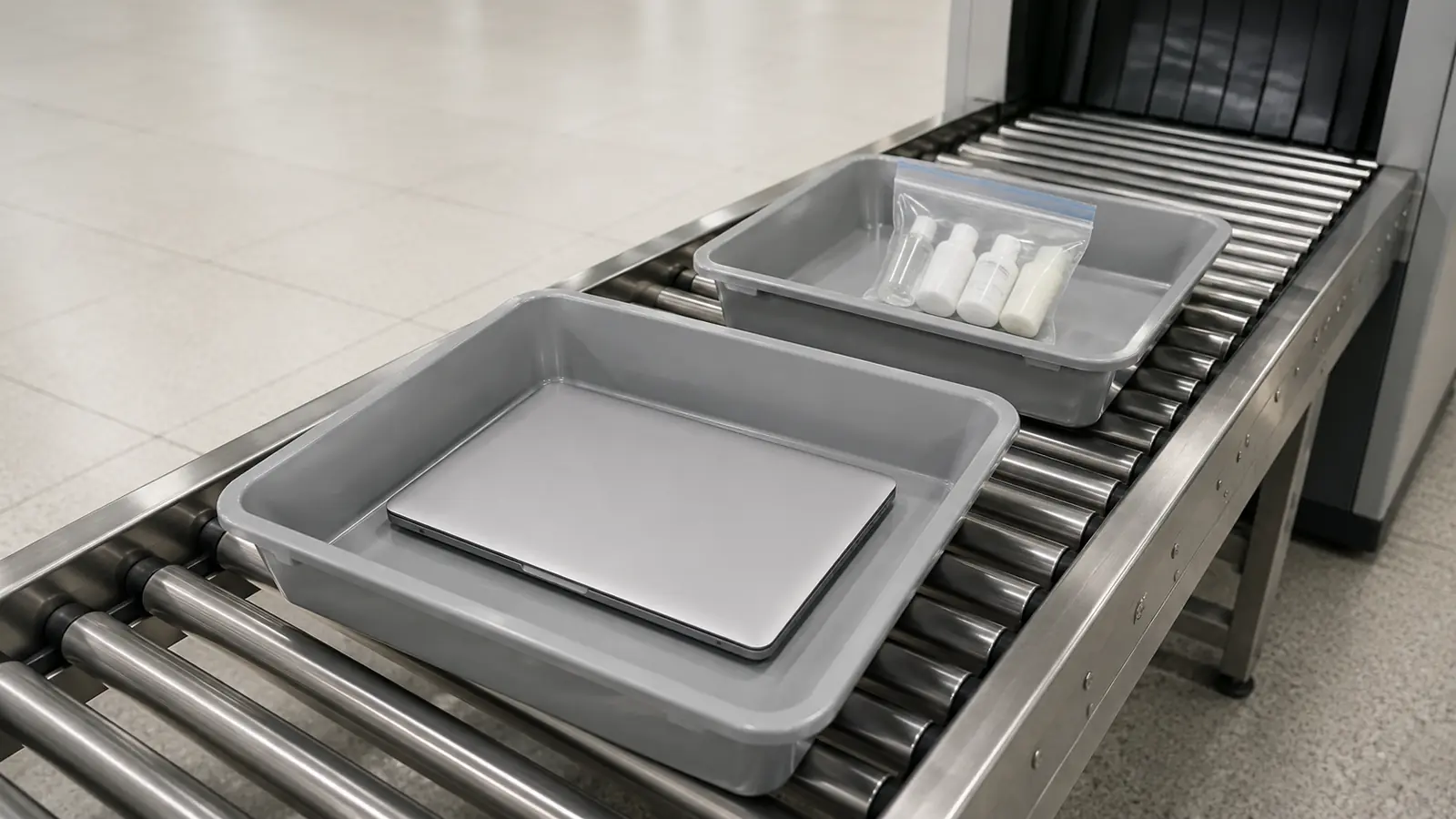
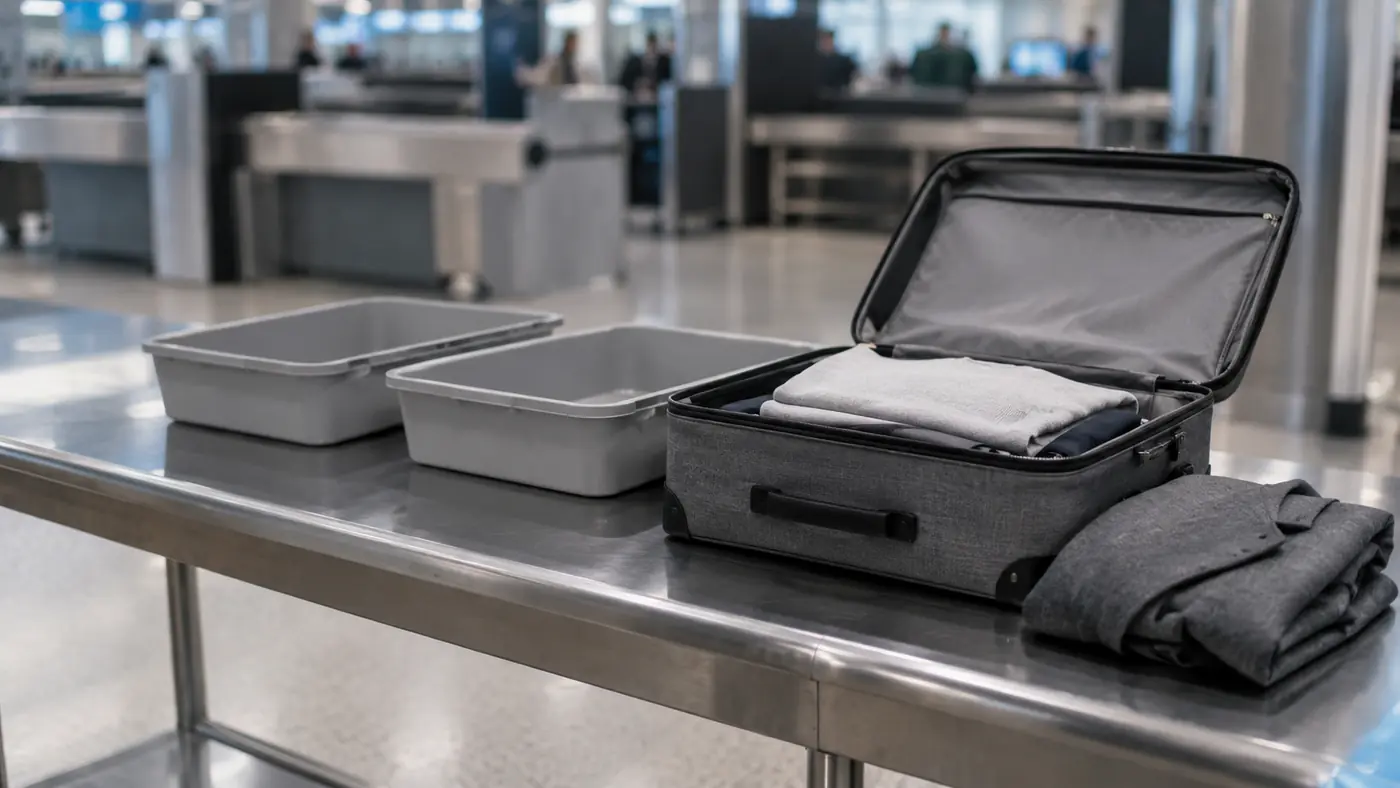
The default, and still the most common. Everything that needs separate assessment comes out of your bag and goes into a bin.
- Liquids bag out and into a bin.
- Laptop out of its case, laid flat, with nothing on top of or underneath it.
- CPAP machine, main unit removed from its carrying case.
- Exempt liquids such as medication, removed and declared.
- Outerwear — a jacket, coat or bulky sweater worn over your clothes — removed and placed neatly in a bin.
- Duty-free purchases in their sealed security bag, placed directly in a bin.
- Loose change, keys and small metal items — put these inside your carry-on before you reach the belt rather than loose in a bin, where they are easy to lose.
Shoe removal is not a routine requirement in Canada. An officer may ask if an alarm needs resolving or if footwear requires separate screening, but you should not assume you will be taking them off.
CATSA Plus.
These checkpoints look different: instead of a single file feeding one belt, several stations let passengers load bins in parallel, and bins are returned automatically.
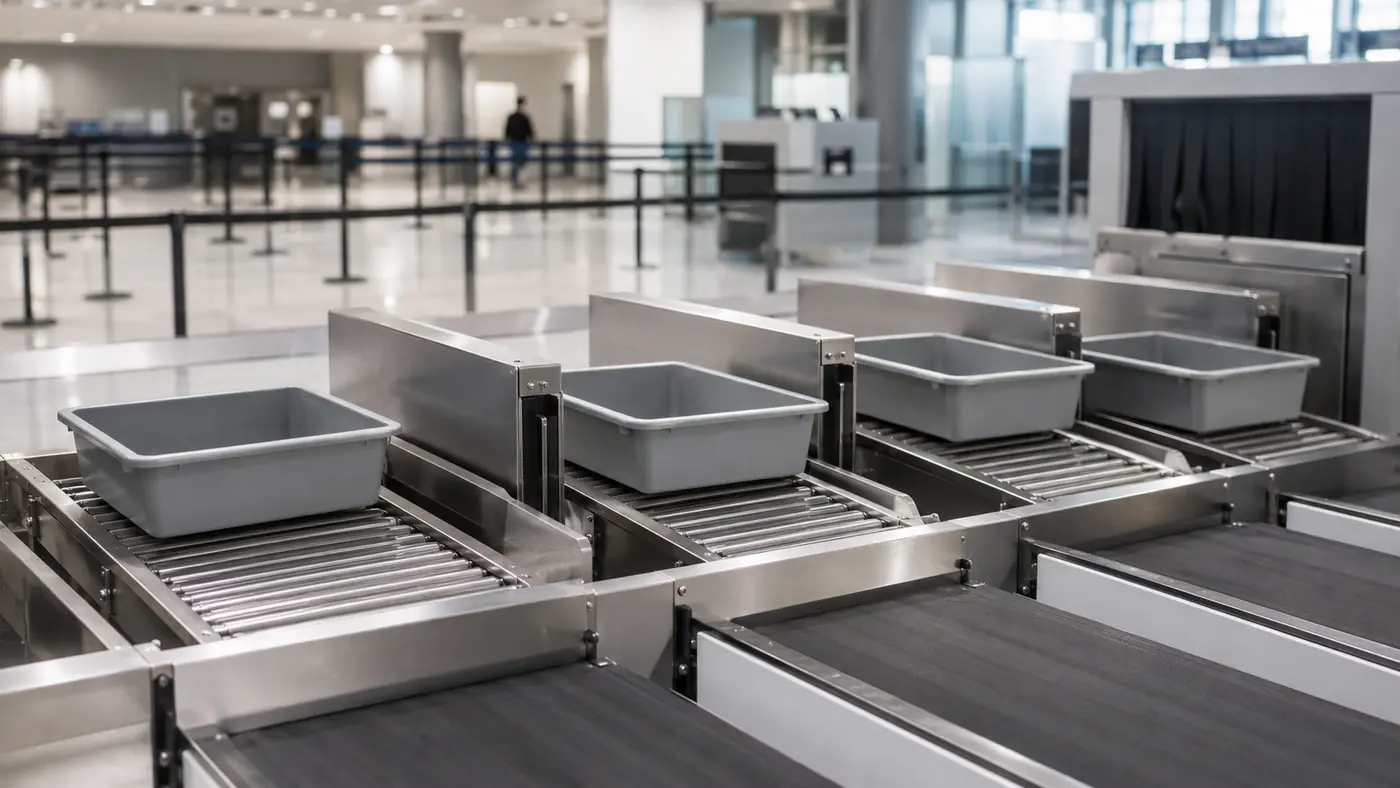
The important clarification, which CATSA states directly: the screening rules at CATSA Plus are the same as at a regular line. Your liquids bag and laptop still come out. What changes is throughput, not divestment.
A few mechanics are worth knowing, because they are not obvious the first time:
- You control the bin order. If something matters to you, put it in the last bin you send through so it is the last to emerge.
- Keep valuables contained. Money clips, watches and passports go in a jacket pocket or inside your carry-on, not loose in a bin.
- Move to the repacking table. Take your bins to the large tables provided rather than sorting yourself out at the end of the belt.
- A missing bin means additional screening. Bins requiring a closer look are automatically diverted to a separate search line. You can repack everything else while you wait.
- Personalise a generic laptop. CATSA suggests a decal or label, since mix-ups at the repacking table are the most common way belongings go astray.
CT-equipped lines.
Computed tomography scanners produce rotatable three-dimensional images rather than the flat two-dimensional views older equipment generates. An officer can turn the image and inspect a bag without you emptying it, which removes most of the reason for divestment in the first place.
On a CT line you may keep large electronics such as laptops, medical devices, and permitted liquids of 100 ml or less inside your carry-on. CATSA displays signage in front of every line where CT is available.
One exception that catches people out. On a CT line, permitted liquids of 100 ml or less stay in the bag, but liquids over 100 ml that are exempt from the rule — prescription medication, breast milk, infant formula — must still be removed and placed in a bin. For more on which liquids qualify, see the full liquids rules and their exemptions.
Beyond Toronto, CATSA lists CT technology on one or more lines at Vancouver, Edmonton, Ottawa, Montréal-Trudeau, Calgary, Québec City, Halifax, Winnipeg and Kelowna. Coverage is by line, so a listed airport does not mean every lane.
Verified Traveller lines.
Fully launched on 21 June 2023, the Verified Traveller programme gives travellers who have undergone extensive background checks added benefits at selected checkpoints. It is the closest Canadian equivalent to expedited screening elsewhere, and it comes with NEXUS membership rather than requiring a separate application.
Who qualifies
- Members of NEXUS and Global Entry
- Serving members of the Canadian Armed Forces and U.S. military, including reservists, with valid ID
- Canadian aircrew in uniform, and airport workers holding a Restricted Area Identification Card
- International aircrew in uniform with valid airline ID
- RCMP officers, and Canadian police officers and constables, with a badge and proper photo identification
One genuinely useful provision that few people know about: co-travellers who are 17 or under, or 75 and over, can accompany a verified traveller through the line when travelling together on the same flight. For a family with young children or an older parent, that is a meaningful benefit.
Domestic benefits versus transborder benefits
This is where the programme is misunderstood, and where CATSA's published benefits lists repay close reading.
On a domestic Verified Traveller line, you may leave permitted liquids in your carry-on, leave laptops and electronics in your carry-on, keep shoes, belts, light jackets and headwear on, and keep small items in your pockets.
On a transborder Verified Traveller line, serving flights to the United States, the published benefits are narrower. Liquids stay in the bag and clothing stays on, but electronics are not on the list. Flying from Pearson to New York with a NEXUS card, expect the laptop to come out.
A note on headwear. Passengers wearing headwear, including religious or cultural head coverings, may keep it on. Additional screening of the covering is required, and if an alarm in the head area cannot be resolved, removal may be requested so a physical search can be conducted.
Front-of-the-line only
At many checkpoints, the Verified Traveller benefit is queue priority rather than reduced divestment. You go to the front; you still take the laptop out and the shoes stay on the same as anyone else. That is the arrangement at Billy Bishop, where the benefit is queue priority only, for both domestic and transborder flights, and at Pearson's international checkpoints.
Verified Travellers are still screened. You will pass through a walk-through metal detector or full body scanner, your carry-on is X-rayed, additional searches may apply, and you can be randomly diverted to a regular line as part of CATSA's layered approach.
TorontoWhich lane is at which Toronto checkpoint.
Combining CATSA's two published lists produces the practical picture for Toronto. Note that at Terminal 1 the CT lines and the full Verified Traveller line are on different levels.
| Checkpoint | CT available | Verified Traveller service | What that means in practice |
|---|---|---|---|
| Pearson T1 — Domestic Level 2 | Yes | Not listed | Everyone can leave electronics and permitted liquids in the bag |
| Pearson T1 — Domestic Level 3 | Not listed | Full Verified Traveller | Eligible travellers keep everything in and clothing on; others divest normally |
| Pearson T1 — International | Yes | Front-of-the-line | CT benefits for everyone; queue priority for eligible travellers |
| Pearson T1 — Transborder | Not listed | Verified Traveller transborder | Liquids stay in and clothing stays on, but the laptop comes out |
| Pearson T3 — Domestic | Not listed | Full Verified Traveller | Eligible travellers keep everything in and clothing on |
| Pearson T3 — International | Not listed | Front-of-the-line | Queue priority only; divest as normal |
| Pearson T3 — Transborder | Not listed | Verified Traveller transborder | Liquids stay in and clothing stays on, but the laptop comes out |
| Billy Bishop — Domestic and transborder | Not listed | Front-of-the-line | Queue priority only; divest as normal |
Since the answer differs by building and by level, it is worth confirming which terminal your flight departs from before you plan around any of this. Both lists are updated periodically, so treat this table as a snapshot rather than a permanent fixture.
What happens to you, not your bag.
Divestment gets the attention, but you are screened separately from your belongings. At major Canadian airports the primary device is the full body scanner, with walk-through metal detectors also in use.
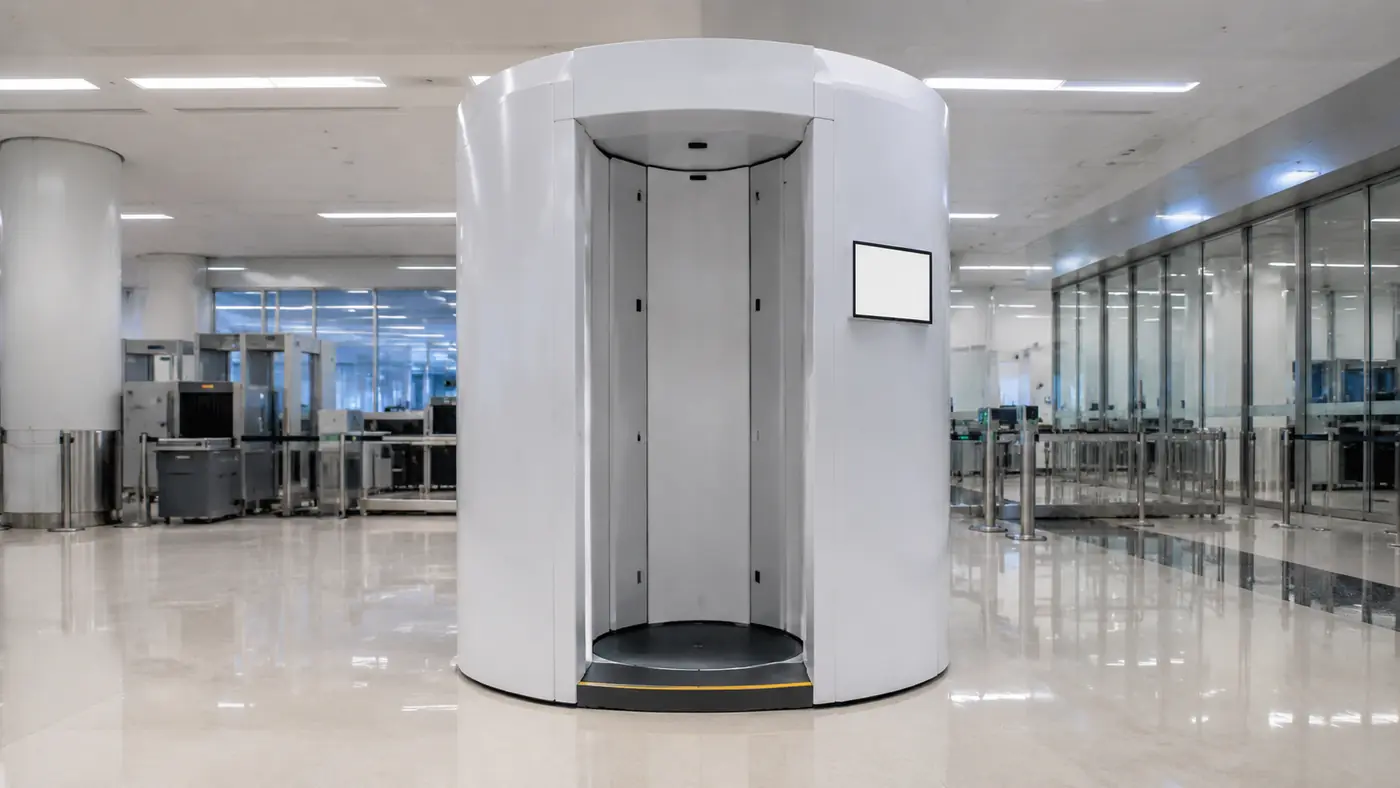
The scanner projects low-level radio frequency energy over and around the body. What the officer sees is a generic figure with no identifying features; if an area of concern appears, it is highlighted on that outline and resolved through standard procedures. Health Canada's assessment places the energy within Canadian exposure guidelines, and CATSA describes it as safe in single or repeated exposures, including for pregnant passengers and those with pacemakers or surgical metal implants.
To be scanned you must be able to walk through unassisted and raise your arms fully above your head. If you cannot, or would prefer not to be scanned, you may request a physical search instead. Tell the officer before screening begins rather than at the portal.
Additional screening.
Being pulled aside is not an accusation. CATSA describes random additional screening as a legislated requirement at all major Canadian airports, designed to build unpredictability into the process. You can also be selected because something alarmed at the scanner, the metal detector or the X-ray.
It may involve a hand-wand, a partial or full pat-down, a search of your carry-on, a body scan, or an explosive trace detection swab. For a trace of a bag, officers swab the carry-on, clothing, shoes or laptop. For a trace of a person, they swab hands, the waist area and a foot or footwear.
Two things worth knowing. You can ask to be screened in a private search room. And declaring anything relevant at the start — a medical device, an implant, a sensitive item — usually shortens the process considerably.
PracticalA faster checkpoint, whatever lane you’re in.
Most of the delay at a checkpoint is self-inflicted and easily avoided.
- Read the signage before joining a queue. It states which services that checkpoint offers.
- Pack for divestment. Liquids bag and laptop near the top, whether or not you expect to need them out.
- Empty your pockets into your bag beforehand rather than into a bin at the belt.
- Have your boarding pass ready. At some airports validation is automated by scanner.
- Leave baggage carts outside the checkpoint.
- Take your bins to the repacking table. Do not reassemble yourself at the end of the belt.
- Return your bin to the end of the line before you leave.
- Never joke about weapons or explosives. It is an offence under the Canadian Aviation Security Regulations.
Seven mistakes that slow people down.
- Assuming last trip's rules apply. Coverage differs by checkpoint and changes over time.
- Thinking CATSA Plus means less divestment. Same rules, different layout.
- Expecting NEXUS to cover electronics on a U.S. flight. The transborder benefits list does not include them.
- Leaving the liquids bag at the bottom of the carry-on. Even on a CT line, exempt items may need to come out.
- Emptying pockets into the bin. That is how watches and passports go missing.
- Putting something on top of the laptop. It must lie flat and alone.
- Treating additional screening as personal. A share of it is random by law.
Arrival timing, from the source.
CATSA's own recommendation is two hours ahead for domestic flights and three hours ahead for flights to the United States and other international destinations. Those are screening-side figures. Your airline may set earlier check-in and bag-drop deadlines, and general wait times fluctuate through the day with passenger volumes and flight schedules.
Knowing your lane helps you use that window well rather than shorten it. If you hold NEXUS and are flying domestically from Terminal 3, the checkpoint should be quick. If you are flying transborder from Terminal 1 at a peak hour with a laptop and a family, it will not be.
The part a transfer actually controls is when you reach the door. A pre-arranged departure ride fixes the pickup to your flight rather than to a guess about traffic, which is what makes CATSA's two- and three-hour figures achievable rather than aspirational. Obsidian Ride operates 24/7 dispatch across Toronto and the GTA, with details on the Pearson Airport chauffeur service page. It is also worth taking a moment to check your flight status before you leave, and our guide to how early to arrive at Pearson breaks the window down by flight type.
Reach the terminal on schedule.
Book a departure transfer against your flight time, so the two hours CATSA recommends are two hours you actually have.
What to take out at airport security: frequently asked questions.
Do you have to take your laptop out at airport security in Canada?
Usually, but not always. On a regular or CATSA Plus line, laptops come out of their case and go flat in a bin. On a CT-equipped line, large electronics can stay in your bag. Verified Travellers on a domestic line can also leave laptops in, though that benefit does not apply on transborder lines.
What is a CT screening line and how do I know if I'm in one?
CT lines use computed tomography scanners producing rotatable three-dimensional images, which lets officers assess a bag without you unpacking it. On those lines, large electronics, medical devices and permitted liquids of 100 ml or less stay in your carry-on. CATSA displays signage in front of every line where CT is available.
Do you have to take your shoes off at airport security in Canada?
Not routinely. Canadian screening does not require shoe removal as standard, though a screening officer may ask if an alarm needs resolving or if footwear requires separate screening. Verified Travellers on eligible lines are explicitly permitted to keep shoes, belts, light jackets and headwear on.
What is the Verified Traveller programme?
Verified Traveller gives travellers who have passed extensive background checks added benefits at select Canadian screening checkpoints. It launched fully on 21 June 2023 and covers NEXUS and Global Entry members, serving Canadian and U.S. military, aircrew, airport workers with Restricted Area Identification Cards, RCMP officers and Canadian police officers.
Which Toronto Pearson checkpoints have Verified Traveller lines?
CATSA currently lists the full Verified Traveller experience at Terminal 1 Domestic Level 3 and Terminal 3 Domestic. The narrower transborder version operates at Terminal 1 and Terminal 3 transborder. Terminal 1 and Terminal 3 international checkpoints offer front-of-the-line service only. Coverage changes, so check CATSA before travelling.
Does NEXUS let you keep your laptop in your bag in Canada?
On a domestic Verified Traveller line, yes. CATSA's domestic benefits include leaving laptops and electronics in your carry-on. The transborder benefits list is narrower and does not include electronics, so flying to the United States you should still expect to take the laptop out even with a NEXUS card.
What is CATSA Plus?
CATSA Plus is a redesigned checkpoint layout that lets several passengers load bins at the same time rather than queuing single file. The screening rules are identical to a regular line, so your liquids bag and laptop still come out. The difference is throughput and layout, not divestment.
Do you have to take off your belt and jacket?
Jackets, coats and bulky sweaters worn over your clothes come off and go in a bin on a regular line. Belts are not routinely required to be removed in Canada, though a metal buckle may trigger an alarm. Verified Travellers on eligible lines may keep belts and light jackets on.
Why was I selected for additional screening?
It may have nothing to do with you. CATSA describes random additional screening as a legislated requirement at all major Canadian airports, alongside selection triggered by an alarm at the body scanner, metal detector or X-ray. It can involve a hand-wand, a physical search, a body scan or an explosive trace detection swab.
Can children or older relatives use the Verified Traveller line with me?
Yes. Co-travellers who are 17 or under, or 75 and over, can accompany a verified traveller through a Verified Traveller line when travelling together on the same flight. This is one of the more useful and least known features of the programme for families.
How early does CATSA recommend arriving at the airport?
CATSA recommends arriving two hours ahead for domestic flights and three hours ahead for flights to the United States and other international destinations. Those are screening-side recommendations; your airline may set its own check-in and bag-drop deadlines, which can be earlier.