
Pearson Airport With Luggage: The Easiest Way to Downtown Toronto.
Getting from Pearson Airport with luggage is not really a question of speed. It is a question of how many times each bag has to leave the ground between the carousel and your room. This guide compares every route into downtown Toronto on that basis, and tells you what fits where.
Every guide to reaching downtown Toronto from Pearson leads with travel times. That is useful if you are carrying a laptop bag. It is close to irrelevant if you have just come off a nine-hour flight with three checked suitcases, a carry-on and a child who has stopped cooperating.
What matters then is a different number: how many separate times you will pick up, carry, set down and reposition each bag. The fastest route on paper is often the one with the most of those moments, and they all happen when you are least equipped to handle them.
Leaving Pearson Airport with luggage is easiest by pre-arranged private transfer or licensed airport taxi, because each bag is lifted twice: in at the terminal curb, out at your destination. The UP Express is fast and inexpensive but involves several handoffs and does not reach your door. Buses have no luggage storage on board.
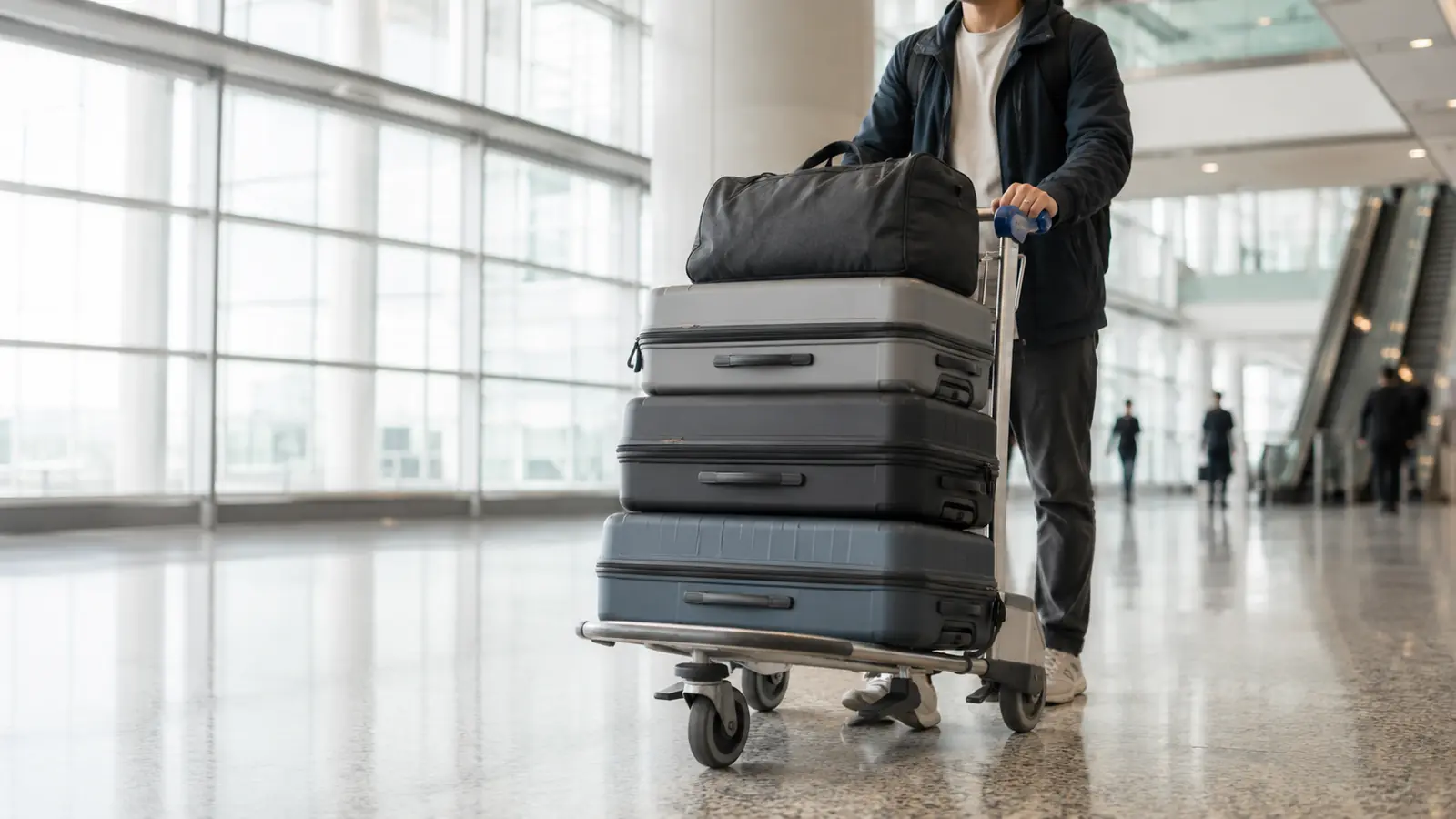
The short answer, by bag count.
If you are travelling with one bag each and no mobility considerations, the UP Express is a genuinely good choice: fast, frequent, and cheaper than any vehicle. Nothing in this guide argues otherwise.
Once you cross roughly two large checked bags per person, or once anyone in your party cannot carry their own, the arithmetic flips. Every additional bag adds friction at four or five separate points on a transit route, and none at all on a door-to-door one.
The rest of this guide sets out where those points are, so you can judge the trade-off for your own trip rather than take anyone's word for it.
At a GlanceCount the handoffs, not the minutes.
A handoff is any point where you must lift, carry or reposition a bag yourself. Here is what each route to a downtown hotel actually asks of you.
| Route | Times you handle each bag | Stairs or outdoor walking | Reaches your door | Best for |
|---|---|---|---|---|
| Private transfer | Two — in at the curb, out at the destination | None | Yes | Groups, families, several checked bags, unfamiliar arrivals |
| Licensed taxi or airport limo | Two, plus loading yourself in a queue | None | Yes | Walk-up convenience without pre-booking |
| Ride-share | Two, plus a walk to a numbered zone | Some, depending on the zone | Yes | One or two bags, off-peak |
| UP Express to Union | Four or more — cart to platform, on, off, then onward | Escalators and lifts, plus the last stretch | No | Solo travellers, light luggage, destinations near Union |
| UP Express plus subway | Six or more | Yes, including an outdoor walk at Bloor | No | Light luggage only |
| TTC bus plus subway | Five or more | Yes, and no onboard bag storage | No | Budget travel with a single bag |
| Rental car | Two, plus a shuttle or walk to the counter | Some | Yes, once parked | Onward road trips, not city centre stays |
One more variable sits upstream of all of this. International arrivals can spend a considerable stretch clearing customs and waiting for bags before any of these decisions become live, and our guide to how long customs and baggage claim actually take covers that side of it.
Start by counting your bags.
Before comparing anything, do this piece of arithmetic. It settles most cases on its own.
- Count wheeled bags, not total bags. A backpack rides on your shoulders. A wheeled suitcase occupies a hand. You have two hands.
- Count free hands in your party. An adult holding a child's hand has one free hand. An adult pushing a stroller has none.
- Compare the two numbers. If wheeled bags exceed free hands, you cannot move as a group without leaving something unattended or making two trips.
That last outcome is what makes transit genuinely unpleasant rather than merely inconvenient. Two trips through a station is not a small inconvenience with bags you cannot leave.
A rough threshold. Two adults with one wheeled bag each plus carry-ons manage transit comfortably. Two adults with four wheeled bags do not, no matter how well organised they are. The line falls somewhere around one wheeled bag per free hand.
The baggage cart boundary.
Pearson is generous with carts. Baggage carts are free, courtesy of CIBC, available 24 hours a day at various locations before security in both terminals, with roughly 5,000 of them across the airport. You can pile everything on one cart and move through the terminal with almost no effort.
Which is precisely why so many travellers misjudge the next part. The cart does not come with you. It stays in the terminal, and everything after that point is carried by hand.
So the useful test is not "can I manage my bags at the airport?" You can; the airport has solved that. The test is: from the moment I leave the cart, can I move every bag myself, in one trip, to my seat? For a taxi or a pre-booked vehicle, that distance is a few metres to a boot. For the train, it is a platform, a carriage, and everything waiting at the other end.
RailTaking the UP Express from Pearson Airport with luggage.
The UP Express runs between the airport and Union Station in about 28 minutes, every 15 minutes, with intermediate stops at Weston, Mount Dennis and Bloor. It is fast, comfortable and considerably cheaper than a vehicle. For the right traveller it is the obvious choice.
What the train itself is like
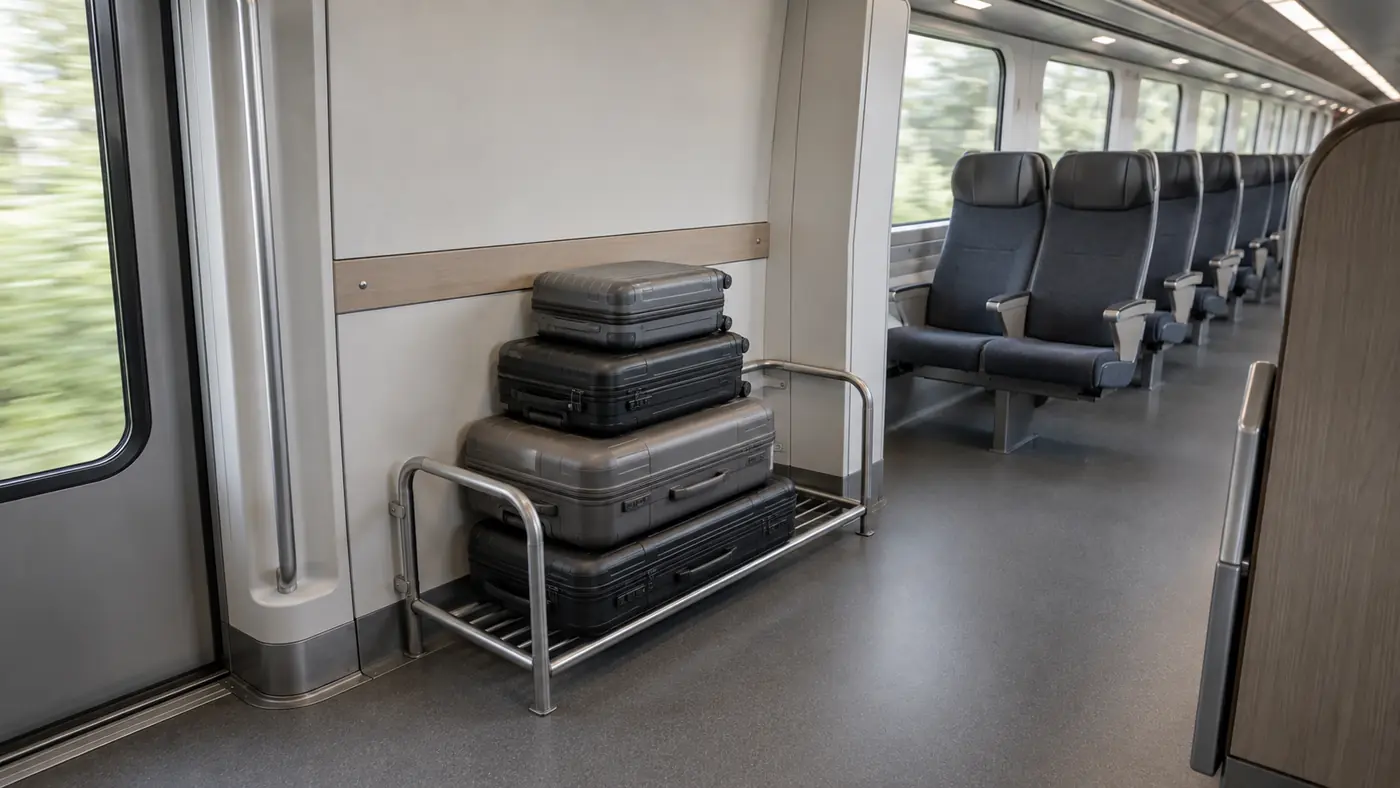
The train is the easy part. UP Express provides storage racks by the entrance of every door for bags, with overhead storage for smaller items, and larger or oversized items go into designated storage areas where space permits. Size and weight limits do apply, and they are published on the operator's FAQ, so check them if you are carrying anything unusual.
The practical constraint is not the rules. It is the rack. Racks are shared, they fill up on busy arrival banks, and if you are carrying more than about two large cases you will find yourself standing beside them rather than sitting.
The Terminal 3 problem
Here is the detail that catches people. The UP Express platform is attached to Terminal 1 only. If you land at Terminal 3, you must first ride the free Terminal Link train across to Terminal 1, then make your way to the UP platform.
That is an entire additional vehicle change, with all your bags, before you have even left the airport. Allow an extra 15 to 20 minutes for it. If you are unclear which terminal your flight uses, our guide explains why the UP Express station sits in Terminal 1 only and what else differs between the two.
What happens at Union
The train ends at Union Station, on a platform inside the interior SkyWalk walkway. Union is a destination for some people and a waypoint for most. Unless your hotel is one of the handful directly connected to the station, you still have to cover the last stretch with your bags in hand, and that may mean a walk of several blocks, a PATH route, or joining a taxi queue at street level.

It is worth pricing that final leg honestly before you commit, because a train fare plus a short taxi at the far end is a different proposition from a train fare alone. For accommodation away from the station, a single vehicle covering hotel transfers across the downtown core removes the split entirely.
Do not transfer at Bloor with heavy bags
This is the single most useful warning in the guide, and it comes from the operator itself. UP Express states that its Bloor Station connection to Dundas West subway station is reached outdoors, via Bloor Street West and Dundas Street West, and takes approximately five minutes on foot.
Five minutes outdoors is nothing in September. In February, with two large cases each, salt-covered pavement and a wind off the lake, it is the worst five minutes of the journey. Competing guides describe this as a convenient connection. It is convenient with a backpack and punishing with suitcases.
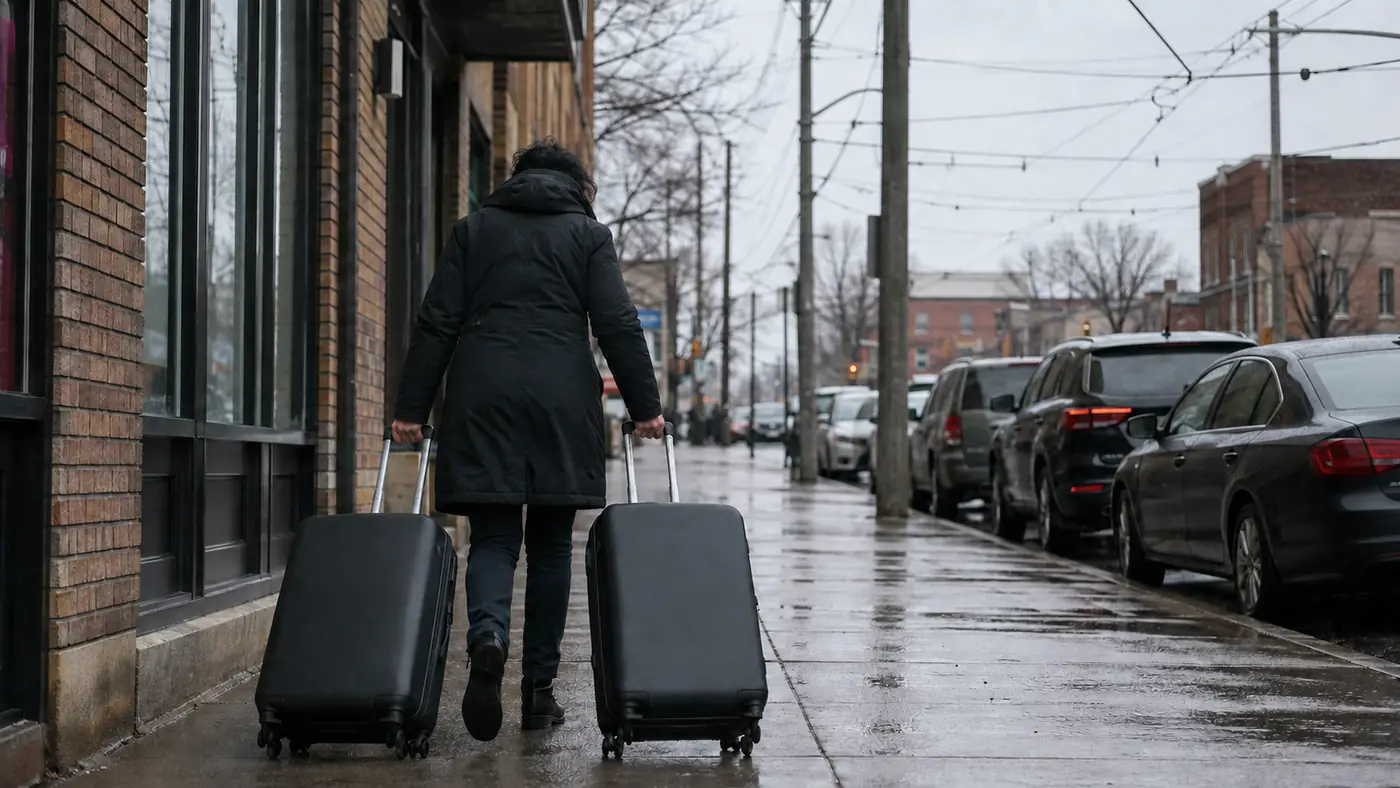
If you use Bloor anyway, note that the station's west tunnel provides elevator access to both the GO and UP platforms, and there is a passenger pick-up and drop-off loop nearby on Dundas Street West. Both are worth knowing about if someone is meeting you there rather than expecting you to reach the subway on foot.
TTC and GO buses with luggage.
Buses serve Pearson well and cost very little. The TTC's 900 Airport Express connects the terminals to Kipling Station on Line 2 in roughly 20 to 25 minutes, and GO Transit routes 40 and 94 run to points across the region from Terminal 1.
The limitation is structural rather than regulatory. City buses and subway cars are not built with luggage storage. There are no racks and no hold. Your bags stay with you, at your feet or in the aisle, for the whole trip, and you are responsible for keeping them out of the way of other passengers.
With one bag, that is fine and thousands of people do it daily. With three large cases between two people, on a busy bus, it is difficult for you and inconsiderate to everyone else standing around them. GO coaches used on some routes do have underfloor compartments, but availability varies by vehicle, so do not plan around it.
One useful piece of fare mechanics if you do go this way: under Ontario's One Fare programme, transferring between the TTC and GO Transit with PRESTO, debit or credit discounts the TTC portion of the trip. UP Express is excluded from that programme.
At the CurbTaxis and airport limousines.
Licensed taxis and airport limousines queue at designated arrivals-level stands and are the straightforward walk-up answer. They charge posted flat rates to Toronto destinations rather than surge pricing, accept major credit cards, and can be identified by a GTAA number plate on the bumper.
On luggage specifically, two things are worth knowing. First, the airport does not publish a per-vehicle bag count, and capacity varies. A sedan is realistically limited to around two large checked bags once passengers are aboard. If you have more than that, tell the attendant at the stand before you take a vehicle rather than after you have started loading.
Second, accessible vehicles capable of carrying a non-folding mobility aid are available on request at the limousine stands at each terminal. Ask; do not assume the vehicle at the head of the queue can accommodate one.
Stand locations differ by terminal, and our guide to where each vehicle type meets you walks the route from the baggage hall to each door.
Ride-share with several bags.
Uber, Lyft and Hopp all operate at Pearson from designated zones that are separate from the taxi stands. At Terminal 1 those zones are on the ground level; at Terminal 3 they are on the arrivals level, and the specific bay is assigned in the app.
Two luggage-specific cautions. The walk to a numbered ride-share bay is longer than the walk to the taxi stand, and it is where you part company with your cart. And the vehicle that arrives is whatever the driver happens to be driving, within the class you selected. If you need boot space, book the larger vehicle class deliberately rather than hoping.
Pricing is also the least predictable of any option here. Apps price dynamically, and a wave of arrivals landing together is exactly when they price highest.
Rental cars.
Worth a short mention for completeness. Rental counters are on site, and a car solves the luggage problem for the drive itself.
It creates two others. You still have to move your bags from the terminal to the rental facility, and a car in the downtown core means paying for parking daily and navigating streets you may not know. For onward road trips out of the region a rental makes sense. For a stay in the city centre with heavy bags, it usually adds work rather than removing it.
Pre-arranged private transfer.
The argument for a pre-booked transfer with heavy luggage is narrow and specific, and it is not about comfort. It is that the vehicle is confirmed to fit your bags before you land, and each bag is handled exactly twice.
That matters most in the situations where transit degrades fastest: several checked bags, small children, a traveller who cannot lift, a destination well away from Union Station, or a late arrival when your patience for problem-solving has run out.
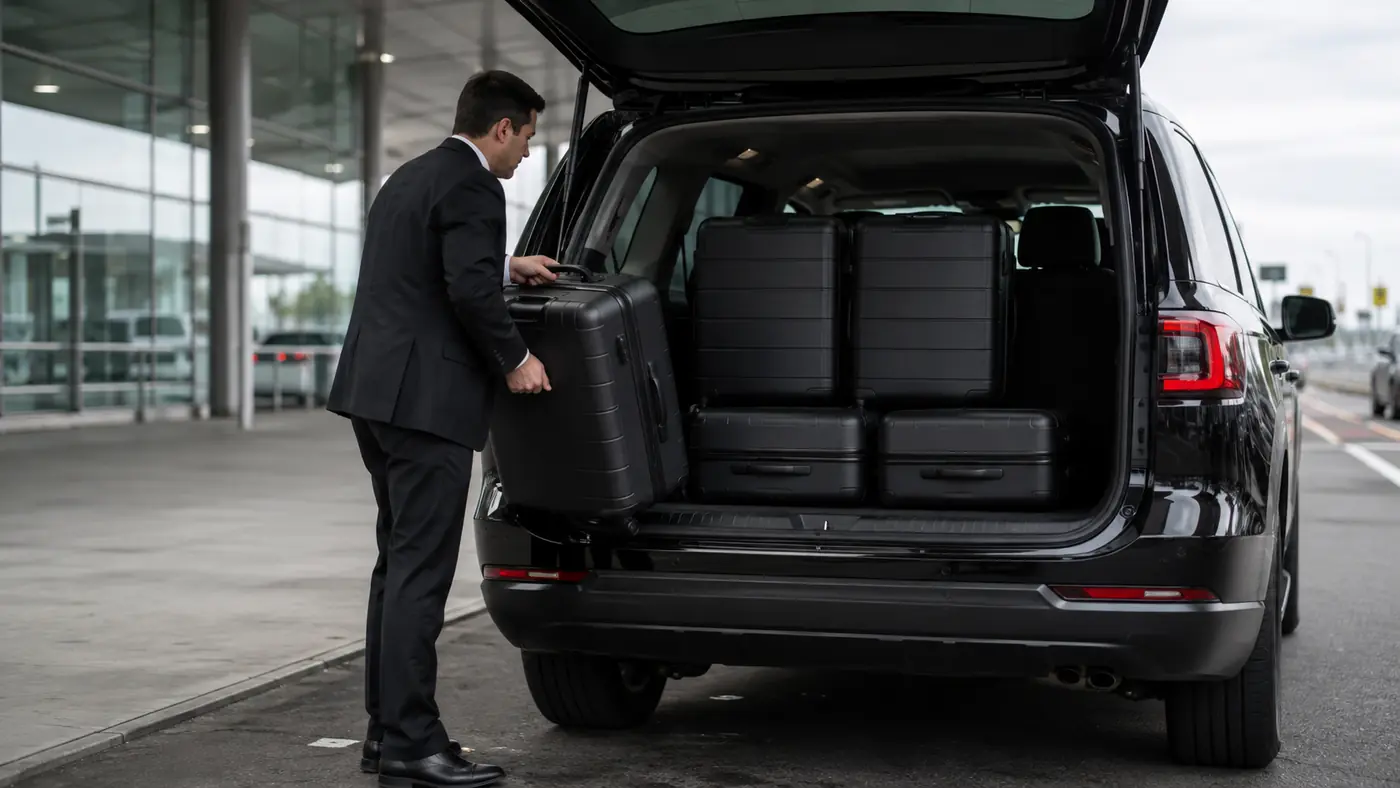
It is the most expensive option in this guide, and for a solo traveller with one bag it is straightforwardly unnecessary. The honest case for it begins at about the point where your bag count exceeds your hands.
SizingMatching your bags to a vehicle.
Whichever provider you use, book by bag count rather than by passenger count. Four adults fit in a sedan. Four adults and six suitcases do not, and discovering that at the curb helps nobody.
Obsidian Ride publishes capacity for each vehicle in its fleet, which gives a workable reference even if you book elsewhere:
| Vehicle | Passengers | Luggage | Mobility aids | Suits |
|---|---|---|---|---|
| Mercedes-Benz S-Class | Up to 3 | 2 checked | Foldable mobility aid | Couples and solo executives travelling light |
| Lincoln Navigator L | Up to 6 | 6 checked | Foldable wheelchair | Families and winter arrivals with full luggage |
| Cadillac Escalade ESV | Up to 6 | 6 large | Foldable wheelchair | Groups wanting space for oversized cases |
| Chevrolet Suburban Premier | Up to 7 | 8 checked | Large cargo area | The highest bag-to-passenger ratio in the fleet |
| Lincoln MKT Stretch | Up to 10 | 2 small | Not wheelchair accessible | Events, not airport luggage runs |
| Mercedes-Benz Sprinter | Up to 14 | 14 checked | Ramp option by advance request | Teams, wedding parties and large family groups |
Note the stretch limousine line. It carries ten people and almost no luggage, which is a useful reminder that vehicle size and luggage capacity are not the same measurement. You can compare passenger and luggage capacity across the fleet in more detail before deciding.
One airport rule to know if you are booking something large. Vehicles must be under 4.5 metres in height to access the arrivals and departures curbs at Terminals 1 and 3. It rarely affects standard SUVs and vans, but it is worth confirming for anything unusual.
Special cases worth planning around.
Families with young children
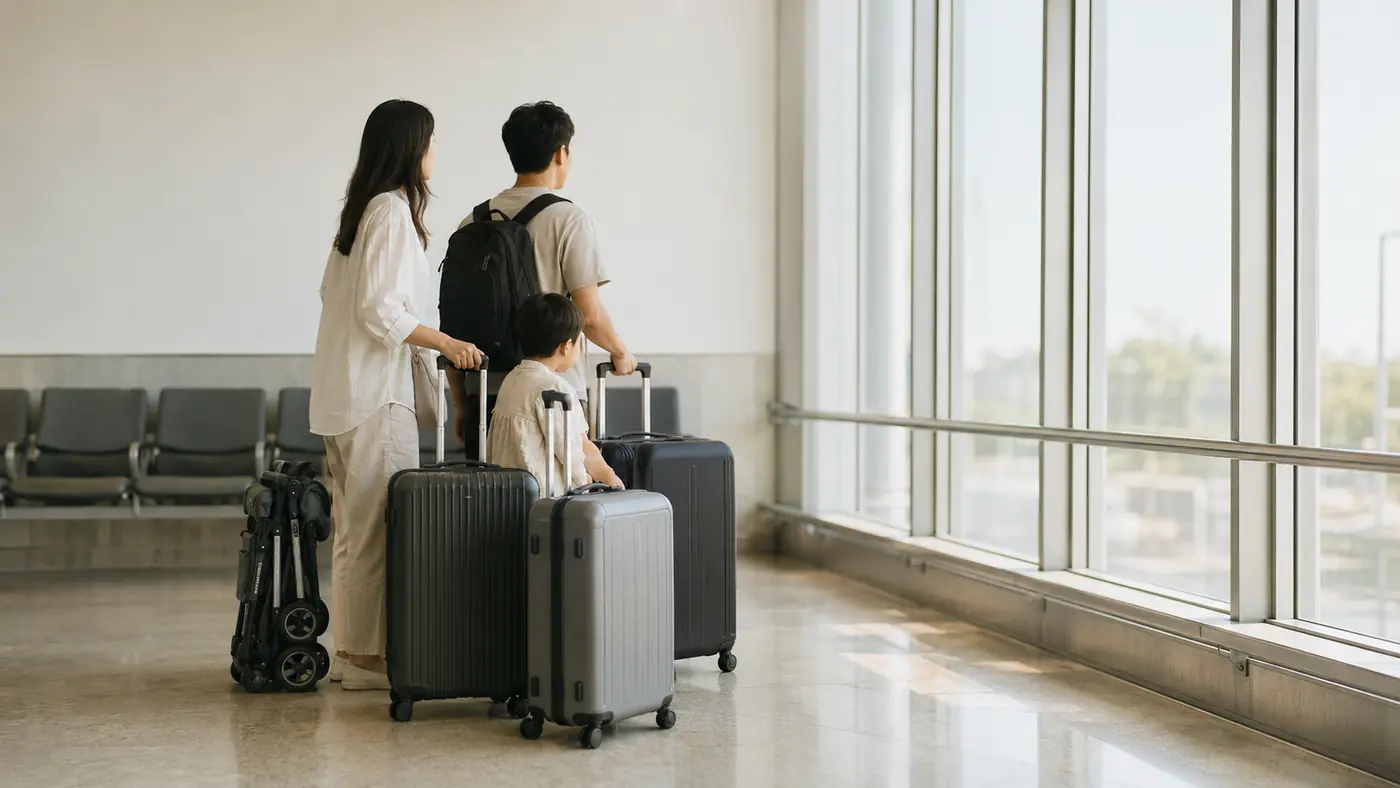
Strollers and car seats change the calculation more than most people expect. A stroller occupies an adult entirely, and a car seat is bulky, awkward and cannot be wheeled. If you are booking a vehicle, say so in advance so the appropriate seating can be confirmed rather than assumed on the day.
Travellers with mobility aids
Accessible vehicles able to carry a non-folding or non-collapsible mobility aid are available on request at the limousine stands at both terminals. Several chauffeur vehicles can carry folded wheelchairs in the luggage area, and ramp access generally needs to be arranged in advance. Whichever route you choose, confirm the specific capability rather than relying on a general accessibility statement.
Oversized and awkward items
Skis, instruments, sports equipment and boxed items follow different rules on every mode. On the train they go into designated oversized storage where space permits, which is not the same as a guarantee. In a vehicle they need boot length, not just boot volume. If you are carrying something long, mention its actual dimensions when booking.
Or send the bags separately.
This option is missing from almost every guide, and for some trips it is the right answer.
Pearson has staffed luggage and coat storage before security in both terminals, for periods ranging from a few hours to several weeks. The same operator offers parcel delivery and baggage transfers to and from hotels. Porter services are also available in the terminals to help you move bags to the curb.
Two situations where this genuinely helps. If you land in the morning and cannot check in until mid-afternoon, storing bags beats dragging them around the city. And if you are arriving with far more than you need for the first day, sending the bulk of it directly to your accommodation lets you travel in on the train unencumbered.
Six mistakes travellers make.
- Judging the route by travel time. Twenty-eight minutes on the train is not the same as twenty-eight minutes of effort.
- Forgetting the cart stops at the terminal. Plan for what you can carry by hand, not what fits on a trolley.
- Assuming the UP Express serves both terminals. It serves Terminal 1 only, and a Terminal 3 arrival adds a whole vehicle change.
- Treating Union Station as the destination. For most downtown accommodation there is still a meaningful last stretch.
- Transferring at Bloor with heavy bags. That connection is an outdoor walk of about five minutes.
- Booking by passenger count. A vehicle that seats your group may not carry your luggage. Book on the higher of the two numbers.
Booking a transfer sized for your luggage.
If you decide a door-to-door vehicle is the right call, the useful part of booking in advance is that capacity is confirmed rather than discovered. Four details do most of the work:
- Bag count and type. Say how many are checked-size and how many are carry-on. They are not interchangeable for boot space.
- Terminal and flight number. Terminal 1 and Terminal 3 have separate roadways, and a tracked flight means a delayed arrival moves the pickup rather than losing it.
- Anything unusual. Car seats, folded wheelchairs, skis, instruments and boxed items all need to be named before travel day.
- Your actual destination. Not "downtown" — the address, so the route and drop-off point are settled in advance.
Obsidian Ride operates 24/7 dispatch with real-time flight monitoring and includes complimentary wait time on airport pickups. Service details are on the Pearson Airport chauffeur service page, with destinations across Toronto and the wider GTA for arrivals heading somewhere other than the core.
Tell us the bag count. We’ll size the vehicle.
Add your passengers, luggage and flight number to the reservation, and the vehicle is confirmed to fit before you land rather than sorted out at the curb.
Leaving Pearson Airport with luggage: frequently asked questions.
What is the easiest way from Pearson to downtown Toronto with a lot of luggage?
A pre-arranged private transfer or a licensed airport taxi is the easiest, because your bags are loaded once at the terminal curb and unloaded once at your destination. Every transit option involves at least two additional handoffs, and the UP Express leaves you at Union Station rather than at your door.
Can you take luggage on the UP Express?
Yes. UP Express trains have storage racks by the entrance of every door for bags, plus overhead storage for smaller items, and oversized items go in designated storage areas where space permits. Size and weight limits do apply, so check the current baggage criteria on the UP Express FAQ before you travel.
Are baggage carts free at Pearson Airport?
Yes. Baggage carts at Toronto Pearson are free to use, courtesy of CIBC, and are available 24 hours a day at various locations before security in both Terminal 1 and Terminal 3. The airport provides roughly 5,000 carts across the site.
Can you take a baggage cart onto the UP Express or a bus?
No. Carts stay within the terminal areas. This is the point most travellers overlook: whichever route you choose, you must be able to move every bag yourself, in one trip, from where you leave the cart to your seat. Count your bags against your hands before deciding.
How many suitcases fit in an airport taxi or limousine from Pearson?
Toronto Pearson does not publish a per-vehicle bag count, and capacity varies by vehicle. A sedan is realistically limited to around two large checked bags with passengers aboard. If you have more, ask the attendant at the taxi or limousine stand for a larger vehicle, or pre-arrange one so capacity is confirmed in advance.
Is the UP Express difficult with heavy luggage?
It is manageable with one or two bags per person and harder beyond that. The train itself is easy; the difficulty is at either end. The airport station is in Terminal 1 only, and at Union Station you still need to cover the last stretch to your accommodation with your bags in hand.
Can you take suitcases on the TTC from Pearson?
You can bring bags on TTC buses and the subway, but there is no dedicated luggage storage on board, so bags stay with you at your feet or in the aisle. It works for light travellers. With multiple large checked bags, particularly at busy times, it becomes difficult for you and for other passengers.
I am arriving at Terminal 3 and want the UP Express. What is involved?
The UP Express station is attached to Terminal 1 only. From Terminal 3 you take the free Terminal Link train to Terminal 1 first, then walk to the UP platform. That is an extra vehicle change with all your bags before you have left the airport, so allow an additional 15 to 20 minutes.
Where can I store luggage at Pearson Airport?
Excess Baggage operates staffed luggage and coat storage before security in both Terminal 1 and Terminal 3, for periods from a few hours to several weeks. The same service offers parcel delivery and baggage transfers to and from hotels, which can be useful if you want to reach your accommodation unencumbered.
What vehicle should I book for four people and six suitcases?
A sedan will not take it. Obsidian Ride lists the Lincoln Navigator L and Cadillac Escalade ESV at up to six passengers with six bags, and the Chevrolet Suburban Premier at up to seven passengers with eight checked bags. Give your passenger and bag count when booking so the vehicle is confirmed rather than assumed.
Is a private transfer worth it just for the luggage?
It depends on your bag count and who is carrying them. With one bag each and no mobility considerations, the UP Express is fast and inexpensive. With several checked bags, small children, an elderly traveller, or a destination away from Union Station, a door-to-door transfer removes handoffs that transit cannot.