
Late Night Transportation From Pearson Airport: What Actually Runs After Midnight.
Late night transportation from Pearson Airport exists around the clock, but the list of what is genuinely operating shrinks hour by hour. This guide sets out what runs between late evening and dawn, where each option meets you, and how to plan a late arrival so the decision is already made before you walk out of the terminal.
The question almost never arrives calmly. It arrives somewhere over the Atlantic, when the seat-back map shows a 12:20 a.m. landing and it occurs to you that you have not thought about the last leg at all. Toronto Pearson handles a steady stream of late-evening and overnight arrivals, and the airport itself keeps operating — but the transport options thin out on a schedule that most travellers only discover at the curb.
The useful way to think about this is not mode by mode. It is hour by hour. A 12:15 a.m. exit and a 2:15 a.m. exit are different problems with different answers, and the difference between them is often nothing more than a slow baggage belt.
Late night transportation from Pearson Airport is available 24 hours a day, but the choices narrow after midnight. Licensed taxis, airport limousines, ride-share vehicles and pre-arranged chauffeurs operate around the clock. UP Express stops running shortly before 1 a.m., while several TTC and GO bus routes continue overnight on reduced schedules.
The short answer: what is open, and what has closed.
Three things run all night at Pearson without interruption: licensed taxis and airport limousines, ride-share vehicles, and pre-arranged private chauffeurs. Two GO Transit bus routes also operate 24 hours a day. The free Terminal Link train between the terminals runs around the clock as well.
One thing stops entirely. UP Express, the rail link to Union Station, has a hard nightly cut-off and a several-hour gap before the first morning train.
Everything else — the TTC’s daytime airport routes, the Blue Night overnight network — operates in windows. Knowing where those windows fall is the whole exercise.
At a GlanceWhat runs at Pearson, hour by hour.
Read this table against the time you expect to be standing outside the terminal with your bags, not against your scheduled landing time. The two are frequently an hour apart.
| Leaving the terminal | Rail | Buses | Curb options |
|---|---|---|---|
| 11:00 p.m. – 12:50 a.m. | UP Express every 15 minutes to Union | TTC 900 to Kipling; TTC 52A until about 1 a.m.; GO 40 and 94 | Taxi, airport limo, ride-share, pre-arranged chauffeur |
| 12:55 a.m. – 1:30 a.m. | Last train has departed | TTC 900 continues; GO 40 and 94 roughly hourly | Taxi, airport limo, ride-share, pre-arranged chauffeur |
| 1:30 a.m. – 2:00 a.m. | None | TTC 334A Blue Night begins; 900 finishing its service day | Taxi, airport limo, ride-share, pre-arranged chauffeur |
| 2:00 a.m. – 5:00 a.m. | None | TTC Blue Night routes 300A, 334A and 352; GO 40 and 94 every one to two hours | Taxi, airport limo, ride-share, pre-arranged chauffeur |
| 5:00 a.m. – 6:30 a.m. | UP Express resumes 5:27 a.m. weekdays, 6:24 a.m. weekends | TTC 900 and 52A from about 5:30 a.m. weekdays and Saturdays; Sunday 900 service starts far later | Taxi, airport limo, ride-share, pre-arranged chauffeur |
One line to remember. Between roughly 1 a.m. and 5 a.m., there is no train. Everything else in that window is either a bus running every thirty minutes to two hours, or a vehicle at the curb.
UP Express: a hard cut-off just before 1 a.m.
UP Express connects Pearson Station, inside Terminal 1, to Union Station downtown in about 28 minutes, with intermediate stops at Weston, Mount Dennis and Bloor. During the day it is the fastest and most predictable way into the city. Overnight it is simply not there.
UP Express lists the last train from Pearson at 12:54 a.m., seven days a week. The first train is 5:27 a.m. on weekdays and 6:24 a.m. on weekends and holidays. Toronto Pearson’s own page lists the final departure slightly later, at 12:57 a.m., so the safe planning assumption is “shortly before 1 a.m.” and a check of the operator’s live schedule on the day you fly.
Two practical details catch people out. The station sits in Terminal 1 only, so a Terminal 3 arrival means riding the Terminal Link across first — add fifteen to twenty minutes to any calculation. And UP Express is not part of Ontario’s One Fare programme, so a PRESTO transfer from another agency does not cover it; that fare is charged separately.
The trap. A flight scheduled to land at 12:20 a.m. looks like it comfortably makes the last train. It usually does not. Deplaning, walking, customs and a baggage belt can consume well over half an hour, and the walk to the platform is not instant. Treat a landing after approximately 11:45 p.m. as unlikely to catch it, and plan the alternative before you board.
TTC after midnight: the 900, then the Blue Night network.
The TTC is the only operator that maintains a genuine overnight network to Pearson. It works in two stages, and the handover happens in the small hours.
Late evening: the 900 Airport Express
The 900 Airport Express runs between Pearson and Kipling Station on Line 2, taking roughly 20 to 25 minutes. TTC lists service from about 5:30 a.m. to 2 a.m. Monday through Saturday. It is the fastest bus option, but the subway itself closes before the 900 does, so a late 900 gets you to Kipling and no further by rail.
Overnight: the Blue Night routes
Blue Night services carry 300-series route numbers and run every 30 minutes or better. TTC’s airport page currently lists three serving Pearson:
- 300A Bloor-Danforth — approximately 2 a.m. to 5 a.m., seven days a week. Around 60 minutes from Yonge and Bloor.
- 334A Eglinton — approximately 1:30 a.m. to 6 a.m. on weekdays and Saturdays, and to 8 a.m. on Sundays, running to and from Kennedy Station. Around 75 minutes.
- 352 Lawrence West — approximately 2 a.m. to 5 a.m., seven days a week, serving the Lawrence West corridor and Sunnybrook. Around 60 minutes.
All of them stop at Terminal 1 ground level and Terminal 3 arrivals level, and all fall within the Toronto fare zone, so a single fare applies. Note one inconsistency worth knowing about: Toronto Pearson’s own transit page also refers to route 332 Eglinton West operating overnight to the airport. Blue Night numbering has been reorganised before. If the difference matters to your route, check the TTC trip planner rather than a printed list.
The Sunday morning problem
This one is genuinely obscure and genuinely costly. TTC lists the 900 Airport Express as starting at approximately 8:15 a.m. on Sundays, more than two and a half hours later than its weekday start. If you have a 7 a.m. Sunday departure, the express bus you were counting on does not exist yet. The 334A runs until 8 a.m. on Sundays and partially covers the gap, but it is a 75-minute local ride from Kennedy Station, not a 20-minute express from Kipling.
Anyone planning an early Sunday flight should read our companion guide on how early to arrive at Pearson alongside this one, because the two constraints compound.
GO Transit: the two routes that never stop.
Less well known than the TTC options, and often more useful if you are heading somewhere other than central Toronto. Two GO bus routes serve Pearson 24 hours a day, seven days a week, both from Terminal 1 ground level.
- Route 40 runs between Hamilton GO Centre and Richmond Hill Centre via Square One, the Mississauga transitway stations and Highway 407 Bus Terminal. Every 20 to 30 minutes during the day, dropping to every one to two hours overnight. Highway 407 Station is 15 to 25 minutes from the airport.
- Route 94 connects Pearson with Yorkdale, Sheppard-Yonge, Scarborough Centre and Pickering, roughly every one to two hours around the clock.
Because both terminate at Terminal 1 only, a Terminal 3 arrival needs the Terminal Link first. If that distinction is new to you, our guide to the Pearson Terminal 1 and Terminal 3 differences explains which services live where.
One helpful piece of fare mechanics: under Ontario’s One Fare programme, transferring between the TTC and GO Transit using PRESTO, debit or credit discounts the TTC portion of the trip. UP Express is excluded from that programme.
At the CurbTaxis and airport limousines: which door, which terminal.
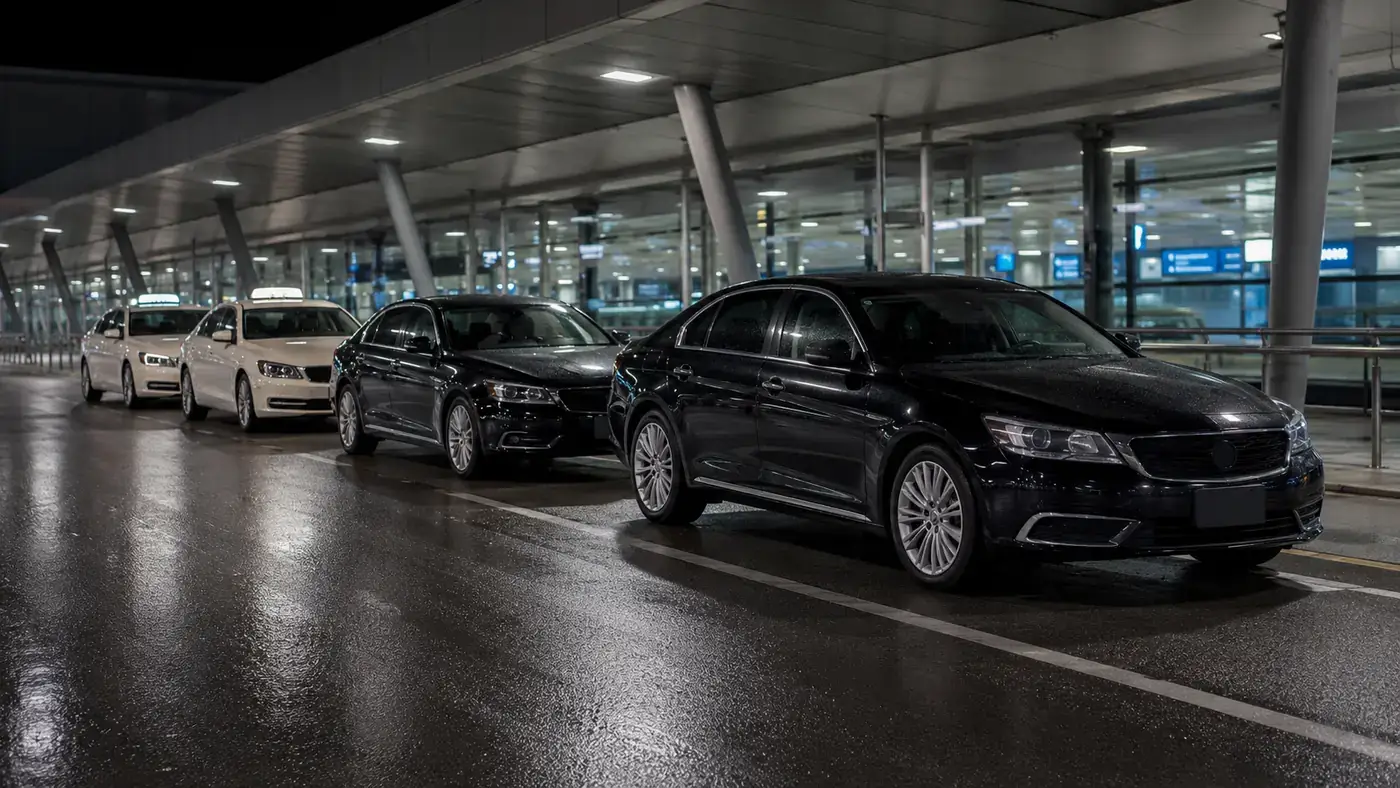
Licensed taxis and airport limousines operate at Pearson around the clock and are the default walk-up option overnight. They queue at designated stands on the arrivals level and, importantly, do not pick up passengers inside the terminals or in the parking garages.
| Terminal | Taxis | Airport limousines | Pre-arranged desk |
|---|---|---|---|
| Terminal 1 | Door D | Door C | Door A |
| Terminal 3 | Door E | Door E | Door A |
Two details matter more at 3 a.m. than they do at noon. First, licensed airport vehicles charge posted flat rates to Toronto destinations rather than surge pricing, accept major credit cards, and can be identified by a GTAA number plate on the bumper and a decal on the window. Toronto Pearson publishes a fare estimate tool so you can check a rate before you queue. Second, airport limousines are premium black cars and are described by the airport as charging roughly ten per cent more than a taxi.
Accessible vehicles able to carry a non-folding mobility aid are available on request at the limousine stands at each terminal. If you need one overnight, ask at the stand rather than assuming the first vehicle in line will work.
If you are unsure which exit puts you closest to the right stand, our terminal-by-terminal pickup points guide walks the route from the baggage hall outward.
Ride-share after midnight: zones, providers and pricing.
Uber, Lyft and Hopp are all licensed to pick up at Pearson. They do not use the taxi stand. They use separate numbered zones, and those zones have been restructured more than once, so follow the in-app instruction and the terminal signage rather than a memory from a previous trip.
According to Toronto Pearson, the current arrangement is:
- Terminal 1, ground level. Zone 3 at Doors P and Q for Lyft and Hopp. Zone 4 at Doors Q and R, and Zone 5 at Doors R and S, for Uber. Uber assigns a specific bay in the app.
- Terminal 3, arrivals level. Zone 2 between Doors B and D for Lyft and Hopp. Zone 3 for all three providers. Zones 4, 5 and 6 for Uber.
- Uber Black and Lyft Lux. Door A at both terminals, alongside the pre-arranged services area.
Pricing is the real overnight variable. Ride-share apps price dynamically, and the overnight driver supply around the airport is thinner than during the day. When several flights land in the same twenty-minute band at 1 a.m., the app is responding to a genuine supply squeeze. This is the one hour of the day when a licensed taxi’s posted flat rate can straightforwardly undercut the app.
Being collected by someone you know.
A friend or family member driving out at 2 a.m. is a perfectly good plan, provided they know where to wait. Toronto Pearson is strict about the terminal roadways and enforces the rules overnight exactly as it does at midday.
- Cell Phone Waiting Area. Free, up to 45 minutes. The driver must switch off the engine and stay with the vehicle. They drive to the curb once you text that you have your bags.
- Express Pass. Twenty minutes free in the covered garages at Terminals 1 and 3, booked online. If you use it, agree the parking level and space in advance.
- Curbside. Brief stops to load or unload only. Waiting is not permitted on the curbs or the roads approaching the terminals, and idling vehicles are monitored 24 hours a day.
- Roadside parking. Photographed and subject to a $50 payment notice, enforced around the clock.
- Height limit. Vehicles must be under 4.5 metres to use the arrivals and departures curbs.
Full current rules are on Toronto Pearson’s picking up and dropping off page.
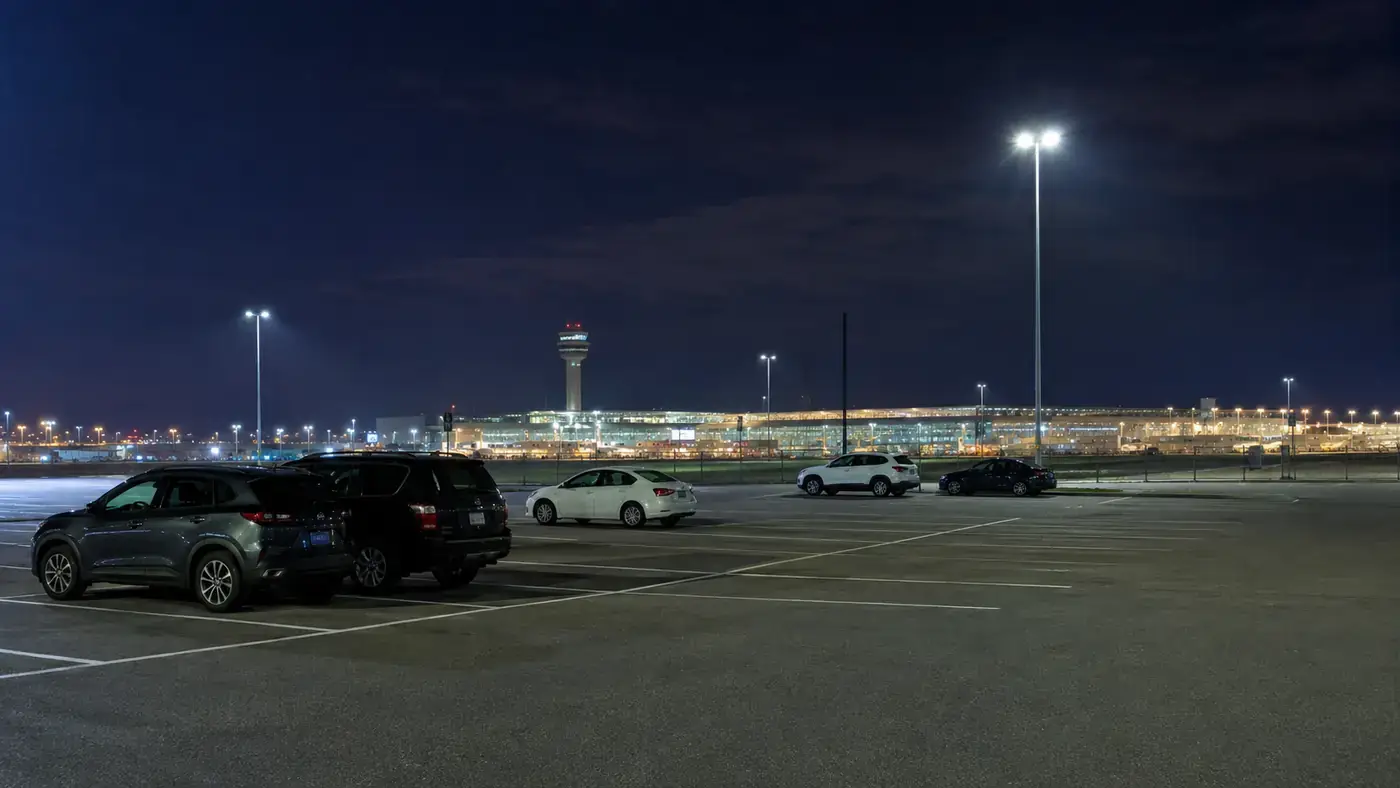
Why a late arrival takes longer than the landing time suggests.
This is the single most useful thing to internalise before a late flight. Toronto Pearson advises people collecting international arrivals to plan for one to three hours after the scheduled landing time, covering border processing and baggage collection.
At most hours of the day that range is an inconvenience. Overnight it is decisive, because it can move you across the boundary from “the train is still running” to “it is not.” A 12:10 a.m. landing that resolves quickly makes the last UP Express. The same landing behind a wide-body wave does not.
A few things compress it. Domestic arrivals and flights precleared through US Customs skip Canadian border processing entirely and go straight to baggage. Travelling with carry-on only removes the belt from the equation, which is frequently the longest single component. Our guide to how long a Pearson customs queue actually takes breaks the variables down further.
The planning rule is simple: build your ground transport plan around the pessimistic exit time, not the optimistic one. If the pessimistic case still works, you have no decision to make when you are tired.
Airport hotels and the 24-hour Terminal Link.
Sometimes the right answer to a 2 a.m. arrival is not to travel at all. The Terminal Link train runs 24 hours a day between Terminal 1, Terminal 3 and Viscount Station, free and with no ticket required. Journey time is two to eight minutes, and overnight the maximum wait is around eight minutes between 12:30 a.m. and 3:30 a.m., tightening to four minutes from 3:30 a.m.
That matters for two reasons. It is how a Terminal 3 arrival reaches the UP Express platform or the Terminal 1 GO bus stops. And it connects directly to the hotels attached to Terminal 3 by covered walkway, which is the practical option if you land at 2 a.m. and have an onward journey that makes more sense in daylight. During scheduled overnight maintenance windows, a shuttle bus substitutes between Viscount Station and both terminals.
ChoosingComparing your options honestly.
None of these is universally right. The correct choice depends on your exit time, your luggage, your destination and how much friction you are willing to absorb at the end of a long day.
| Option | Overnight availability | Pricing behaviour | Best for |
|---|---|---|---|
| UP Express | Stops shortly before 1 a.m.; resumes 5:27 a.m. weekdays | Fixed published fare | Solo travellers with light luggage heading to Union Station before the cut-off |
| TTC Blue Night bus | Roughly 1:30 a.m. to 5 a.m., every 30 minutes or better | Single Toronto fare | Budget-conscious travellers with light bags who are not in a hurry |
| GO bus 40 and 94 | 24 hours, every one to two hours overnight | Distance-based GO fare | Destinations in Mississauga, Hamilton, York Region or Scarborough |
| Licensed taxi | 24 hours at the arrivals-level stand | Posted flat rate to Toronto destinations | Walk-up convenience without app pricing exposure |
| Airport limousine | 24 hours at the arrivals-level stand | Posted rate, described by the airport as about 10% above taxi | Travellers wanting a black car without pre-booking |
| Ride-share | 24 hours in the designated zones | Dynamic, and most volatile overnight | Short trips when supply happens to be good |
| Pre-arranged chauffeur | 24 hours, assigned before the flight lands | Rate confirmed at booking | Groups, families, heavy luggage, unfamiliar arrivals, time-sensitive onward travel |
Public transit at Pearson is well run and perfectly usable overnight. The honest limitations are frequency and journey time, not safety. If you are travelling light, know the city, and your destination sits near a Blue Night corridor, the bus is a sensible choice at 3 a.m. If you have three suitcases, two children, a suburban destination and no local knowledge, it is not.
Before You TravelA short checklist for a late arrival.
- Confirm your terminal. Ground transport differs between Terminal 1 and Terminal 3, and your boarding pass is the authoritative source.
- Calculate a pessimistic exit time. Scheduled landing plus one to three hours for an international arrival, less for domestic or precleared.
- Check that against the UP Express cut-off. If it lands after roughly 12:30 a.m., assume the train is gone.
- Choose a default and a backup. Decide on the ground before you fly. Deciding at the curb at 2 a.m. is how people end up paying a surge fare they did not need to.
- Charge your phone. Ride-share zones, transit apps and messaging a waiting driver all assume a working battery after a long flight.
- Tell whoever is meeting you three things. Terminal, flight number, and whether the flight is domestic or international.
- If you are pre-booking, do it 24 to 48 hours ahead. Overnight coverage is easier to arrange with notice than at the last minute.
Five mistakes late arrivals make at Pearson.
- Assuming the train runs all night. It does not, and this is the most common and most expensive assumption.
- Walking to the taxi stand expecting a ride-share. They are separate locations. At Terminal 1 the taxi stand is on the arrivals level and the ride-share zones are on the ground level.
- Planning against the landing time. The number that matters is the time you clear the baggage hall.
- Having a driver wait on the terminal roadway. That is a $50 payment notice, enforced 24 hours a day. The cell phone waiting area is free.
- Booking a Sunday dawn departure around the 900 bus. On Sundays it does not begin running until roughly 8:15 a.m.
Pre-arranged chauffeur transport for a late Pearson arrival.
The defining feature of the overnight window is that every walk-up option is decided after you land, when your negotiating position is weakest. A pre-arranged transfer inverts that: the vehicle, the rate and the meeting point are all settled while you are still at home.
Obsidian Ride operates 24/7 dispatch with real-time flight monitoring, which is the part that matters most for late arrivals. Your flight number is attached to the reservation, so a delayed inbound moves the pickup rather than losing it, and complimentary wait time is included on airport transfers.
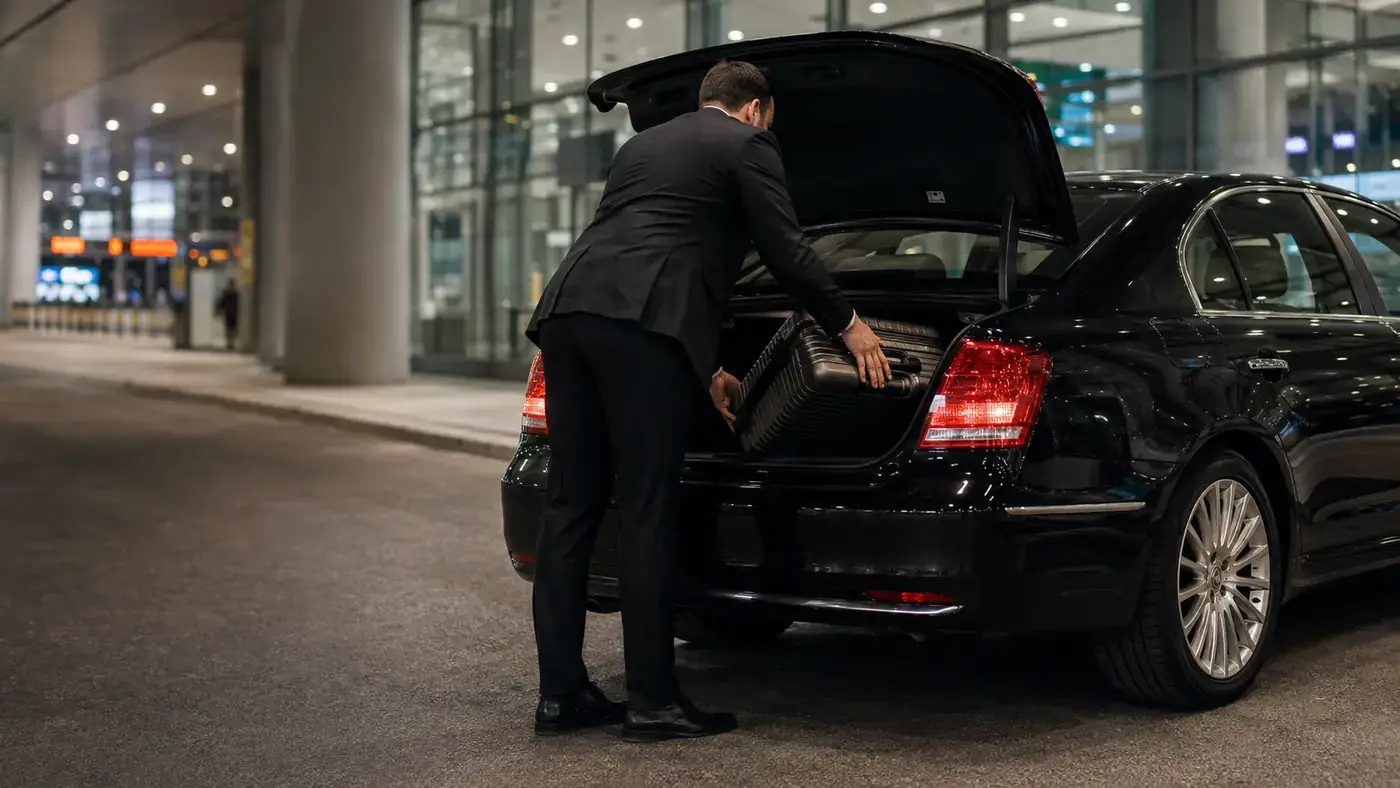
When you book an overnight arrival, four details do most of the work:
- Flight number and airline. This is what allows the arrival to be tracked and the dispatch time adjusted.
- Terminal. Terminal 1 and Terminal 3 have separate roadways and separate meeting arrangements.
- Domestic or international. It changes the realistic exit window considerably.
- Passenger and luggage count. A sedan suits two travellers with carry-ons; four people returning from a long trip need an SUV. It is worth a look at match the vehicle to your luggage before confirming.
Obsidian Ride provides pre-arranged private transfers to and from both Pearson terminals across Toronto and the wider GTA, including corporate travel accounts for teams whose inbound legs regularly land after midnight. Full details are on the Pearson Airport chauffeur service page.
Arrange the late leg before you fly.
Add your flight number and terminal to the reservation and your arrival is monitored, so a delay moves the pickup instead of ending it. Rate confirmed before travel day.
Late night transportation from Pearson Airport: frequently asked questions.
Is there transportation from Pearson Airport late at night?
Yes. Toronto Pearson has ground transportation available 24 hours a day, though the choices narrow considerably after midnight. Licensed taxis and airport limousines, ride-share vehicles and pre-arranged private chauffeurs all operate through the night. UP Express stops before 1 a.m., while several TTC and GO bus routes continue on reduced overnight schedules.
What time does the last UP Express train leave Pearson?
UP Express lists the last train from Pearson Station at 12:54 a.m., seven days a week. Toronto Pearson’s own page lists 12:57 a.m., so treat the final departure as “shortly before 1 a.m.” and confirm on the UP Express website before you travel. Service resumes at 5:27 a.m. on weekdays and 6:24 a.m. on weekends and holidays.
How do I get from Pearson to downtown Toronto after midnight?
Between roughly 1 a.m. and 5 a.m. your realistic choices are a licensed taxi or airport limousine from the arrivals-level stand, a ride-share from the designated zone, a pre-arranged chauffeur, or the TTC Blue Night network. The Blue Night buses reach downtown but take around an hour from the airport and run every 30 minutes or better.
Do TTC buses run to Pearson Airport all night?
Yes, on overnight Blue Night routes rather than the usual daytime services. TTC’s airport page lists 300A Bloor-Danforth and 352 Lawrence West operating roughly 2 a.m. to 5 a.m., and 334A Eglinton from about 1:30 a.m. to 6 a.m., extending to 8 a.m. on Sundays. All stop at Terminal 1 ground level and Terminal 3 arrivals level.
Are taxis available at Pearson Airport at 3 a.m.?
Licensed taxis and airport limousines serve Pearson around the clock, queuing at designated arrivals-level stands. At Terminal 1, taxis wait at Door D and limousines at Door C. At Terminal 3, both use Door E. Volumes are thinner overnight than during daytime arrival banks, so a short wait is normal.
Where do ride-share vehicles pick up at Pearson late at night?
Uber, Lyft and Hopp use designated zones, not the taxi stand. At Terminal 1 the zones are on the ground level: Zone 3 at Doors P and Q for Lyft and Hopp, and Zones 4 and 5 at Doors Q through S for Uber. At Terminal 3 the zones sit on the arrivals level between Doors B and D. Uber Black and Lyft Lux meet at Door A in both terminals.
Why do late-night fares from Pearson vary so much?
Licensed airport taxis and limousines charge posted flat rates to Toronto destinations rather than surge pricing, and Toronto Pearson publishes a fare estimate tool. Ride-share apps price dynamically, so a thin overnight driver supply combined with a wave of arriving flights can push app pricing well above a daytime quote for the same trip.
How long does it take to get out of Pearson on a late international arrival?
Toronto Pearson advises that international arrivals can take one to three hours to clear customs and collect checked baggage. That figure matters more overnight than at any other time, because a 12:40 a.m. landing can easily become a 1:45 a.m. exit — well after the last UP Express train has departed.
Can someone pick me up at Pearson at 2 a.m.?
Yes. Toronto Pearson’s free Cell Phone Waiting Area lets a driver wait up to 45 minutes, engine off, and stay with the vehicle. The Express Pass gives 20 minutes free in the terminal garages. Waiting on the terminal curbs or roadsides is not permitted; roadside parking carries a $50 payment notice, enforced 24 hours a day.
Should I book a chauffeur in advance for a late-night Pearson arrival?
Advance booking is what removes the uncertainty from the overnight window, because the vehicle is assigned before you land rather than sourced after. Obsidian Ride recommends reserving airport transfers 24 to 48 hours ahead, and its dispatch operates 24/7 for late arrivals across Toronto and the GTA.
What happens to my late-night pickup if my flight is delayed?
With a pre-arranged transfer, your flight number is attached to the reservation and the arrival is monitored, so the chauffeur’s dispatch time shifts with the actual landing. Obsidian Ride includes complimentary wait time on airport pickups. Without a pre-arrangement, a delay simply returns you to whatever is available at the curb when you finally walk out.