
Where to Stay in Toronto: The Right Neighbourhood for Your Trip.
Where to stay in Toronto depends less on which neighbourhood is best and more on what kind of trip you are taking. This guide matches the central areas to first visits, business travel, families and nightlife, explains when an airport hotel makes sense, and covers the two things that catch travellers out after booking: the rental rules and the tax on the bill.
Booking sites describe almost every Toronto hotel as central. Some are. Many are central to somewhere, which is not the same thing, and the difference becomes clear on the first morning when the walk to the waterfront turns out to be a forty-minute commute.
The useful way to choose is to start with the trip rather than the hotel: decide what you will spend your days doing, then find the area that puts those things closest. For orientation and how the transit system works, see our Toronto travel guide.
For most first visits, the answer to where to stay in Toronto is downtown, between the waterfront and Bloor Street, near Union Station or a Line 1 subway stop. The Financial District suits business travel, Harbourfront suits families, King West and Queen West suit nightlife, and Yorkville suits travellers who want somewhere quieter. Stay near Pearson only for a single-night stopover.
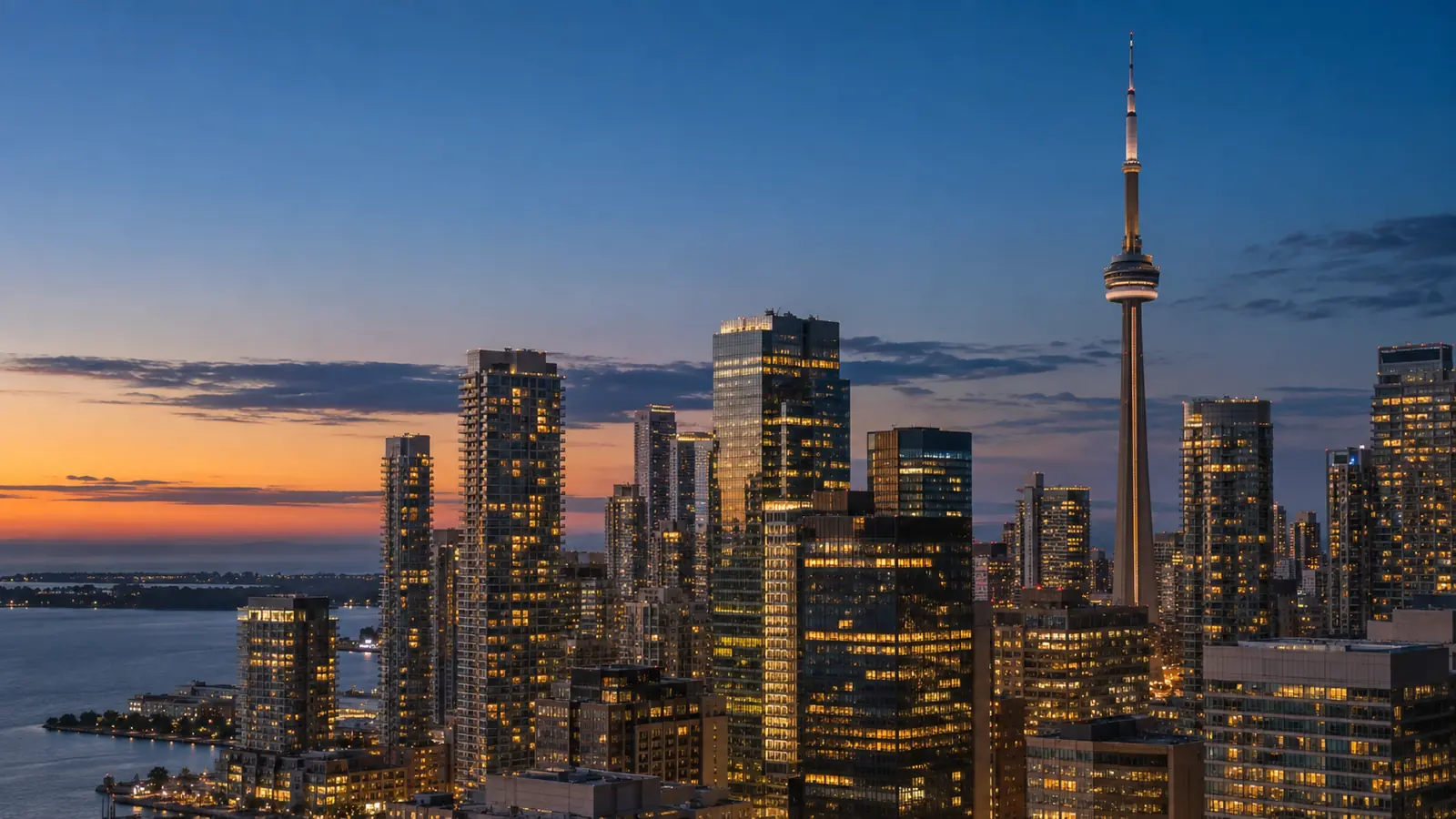
The one rule.
Stay close to one of Toronto's three transit anchors: Union Station, a Line 1 subway station, or a Line 2 subway station. Nearly everything a visitor wants to see sits near at least one of them, and Union Station also has the UP Express to the airport.
In practice that points to the area between the waterfront and Bloor Street, bounded roughly by the Don Valley to the east and Bathurst Street to the west. Within that area, the choice is about character rather than convenience.
At a GlanceChoose by the kind of trip.
| Your trip | Best area | Why | Also consider |
|---|---|---|---|
| First visit | Financial or Entertainment District | Closest to the waterfront, CN Tower and Union Station | St. Lawrence |
| Business | Financial District | Walking distance to the office towers; connected underground by the PATH | Yorkville |
| Family | Harbourfront | Water, ferry terminal and major attractions on foot | Financial District, Yorkville |
| Food | St. Lawrence and Old Town | The market, the Distillery District and older streets on the doorstep | Queen West |
| Nightlife | King West and Entertainment District | Concentrated restaurants and bars, close to the core | Queen West |
| Quiet and upscale | Yorkville | Calmer streets, boutiques, galleries, both subway lines | The Annex |
| Longer stay | The Annex | Residential feel with cafés and bookshops, on Line 2 | Yorkville |
| One-night stopover | Near Pearson | Minimal travel before or after a flight | — |
If you have already planned your days, our three-day itinerary and weekend itinerary both start from a downtown base near Union Station or Line 1.
NeighbourhoodsThe neighbourhoods.
Financial District
The towers south of Queen Street and north of the rail corridor. Busy by day, quieter in the evenings and at weekends, and the most practical base for a business trip. Union Station sits at its southern edge, and much of the district is linked underground by the PATH walkway network, which is a real advantage in winter. Business travellers with regular trips may find corporate travel accounts useful for moving between meetings.
Suits: business travellers, first-timers who want maximum convenience. Trade-off: less neighbourhood character after office hours.
Entertainment District and King West
West of the Financial District, around the theatres, the CN Tower and the stadium, then running along King Street West. The liveliest part of downtown in the evening, with restaurants and bars concentrated along King. Close to the waterfront and Union Station.
Suits: first visits, nightlife, theatre and sports trips. Trade-off: noise on weekend nights; ask for a room away from the street.
St. Lawrence and Old Town
East of Yonge Street, around St. Lawrence Market and the older Victorian streets of the city's original town site, with the Distillery District a short walk further east. Lower-rise and more characterful than the core, while still within walking distance of it.
Suits: food-focused travellers, repeat visitors, anyone who prefers older streets. Trade-off: slightly further from the western nightlife streets.
Harbourfront
Along the lake south of the rail corridor, with waterfront paths, the ferry terminal to the Toronto Islands and the CN Tower within walking distance. The most relaxed central base in summer.

Suits: families, summer visits, travellers arriving at Billy Bishop. Trade-off: a longer walk to the subway than the core, and quieter in winter.
Yorkville
North of downtown around Bloor Street, next to the Royal Ontario Museum. Quieter, upscale and polished, with boutiques, galleries and restaurants in restored Victorian houses. It sits near interchange stations on both Line 1 and Line 2, which makes the rest of the city easy to reach.
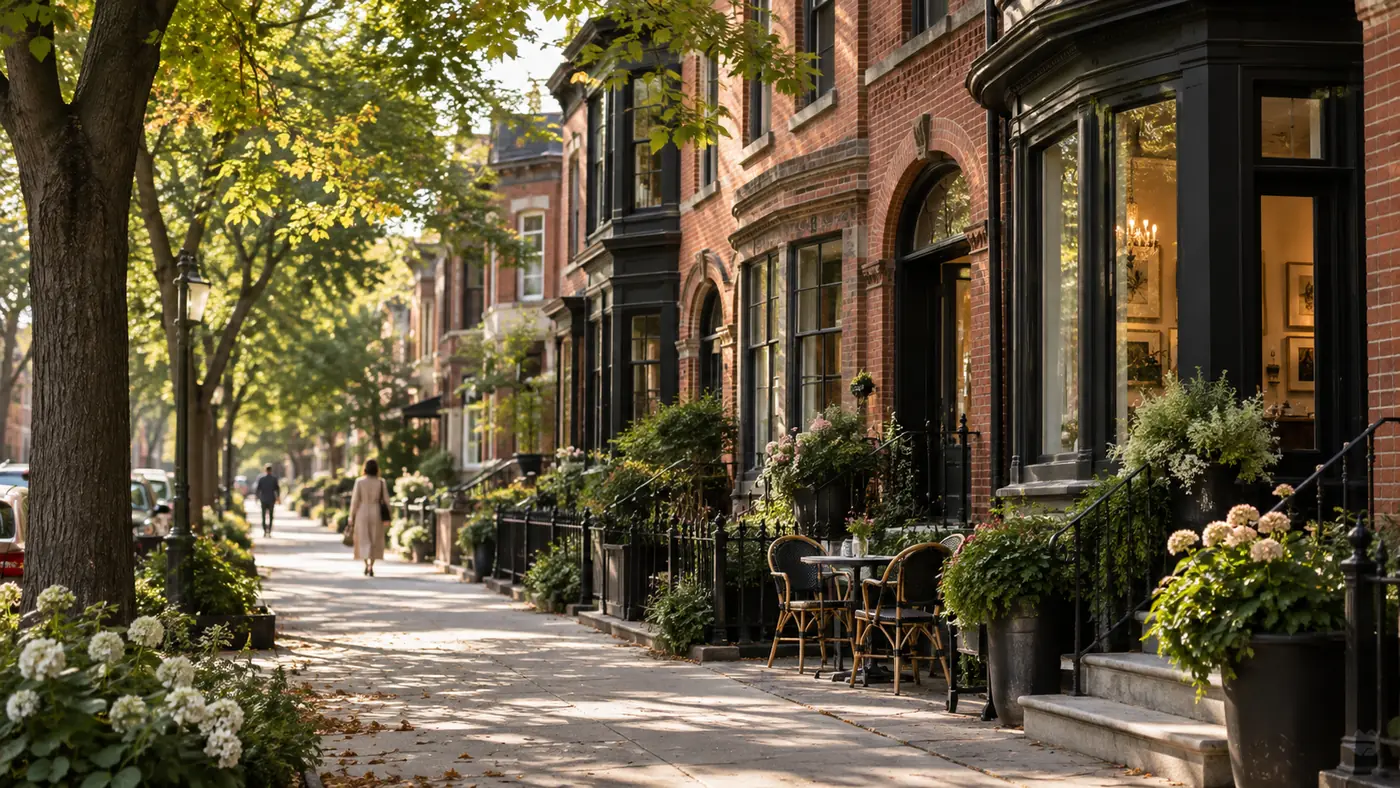
Suits: travellers wanting calm, repeat visitors, museum-focused trips. Trade-off: the waterfront is a subway ride away rather than a walk.
Queen West
Queen Street West, running west from around the AGO toward and beyond Trinity Bellwoods Park. Known for independent shops, restaurants, bars and a more local feel than King West. Well served by streetcar, with Kensington Market close by.
Suits: food, nightlife, travellers who want a neighbourhood rather than a hotel district. Trade-off: hotel choice is thinner than in the core.
The Annex
West of Yorkville along Bloor Street, around the university. Residential, relaxed, with cafés, bookshops and inexpensive restaurants, on Line 2.
Suits: longer stays, travellers who want a lived-in neighbourhood. Trade-off: fewer hotels, and further from the waterfront.
Staying near the airport.
An airport hotel is the right choice for one specific situation: a single night before an early flight, after a late arrival you do not want to extend, or for a meeting near the airport. At Pearson, the free Terminal Link train runs between Terminal 1, Terminal 3, Viscount Station and the airport hotels around the clock, which removes most of the logistics.
For anything longer, an airport hotel leaves you far from everything you came to see, and the savings rarely justify the daily travel. Stay downtown and make the airport journey once in each direction.
Where not to stay on a first visit.
Not because these areas are bad, but because they are wrong for a sightseeing trip.
- Suburban hotels outside the core. Often good value, but every day starts with a long journey into town.
- Airport hotels for multi-night stays. Convenient for one night, a poor base for three.
- Anywhere far from a subway station. A hotel that looks close on a map can be a long walk from the nearest station.
Each of these makes sense for a particular purpose, such as a family visit in the suburbs or a conference near the airport. They are simply not the right starting point for a first look at the city.
BookingHotel or short-term rental?
Short-term rentals can suit longer stays and families who want a kitchen. In Toronto they come with specific rules that are worth understanding before you book, because they determine whether a listing is legitimate.
Under the City of Toronto's rules, short-term rentals of under 28 consecutive days are permitted only in the host's principal residence. Hosts can rent up to three bedrooms in that home without an annual limit, or the entire home for up to 180 nights a year, and must register with the City. Since 30 September 2024 the City has allowed only one registration per dwelling unit.

The check to make. Hosts are required to display their City registration number on their listing, and Airbnb states that Toronto listings without a valid registration number or exemption are blocked from hosting stays of under 28 nights. If a listing for a short stay shows no registration number, treat that as a reason for caution.
These are obligations on the host rather than the guest. But a listing that ignores them is more likely to be cancelled at short notice, which is the outcome that actually affects a traveller.
What your bill will include.
Toronto adds a Municipal Accommodation Tax to hotel and short-term rental stays. Two points are worth knowing, one of them very recent.
First, the rate. From 1 August 2026, the tax returned to 6%, after a temporary increase to 8.5% ended. Some booking guides and older articles still quote the higher figure.
Second, what it applies to. According to the City's guidance for guests, the tax applies only to the room portion of the stay and appears as a separate line on hotel invoices. Meeting rooms, food and drink, room service, internet and phone charges are excluded, provided they are itemised separately. HST also applies to accommodation in Ontario.

The practical point: when comparing prices across booking sites, check whether the quoted rate includes taxes. Two hotels at the same headline price can differ noticeably at checkout.
Before you book: a short checklist.
- Check the walk to the nearest subway station or to Union Station, not just the distance to downtown.
- Check what is on the street outside. A hotel on King West or in the Entertainment District can be loud on weekend nights.
- Check for events. Major concerts, sports fixtures and conferences push up prices and fill downtown hotels.
- Confirm whether taxes are included in the quoted rate.
- For a short-term rental, look for the City registration number on the listing.
- Match the hotel to your airport. A Union Station base suits Pearson via the UP Express; Harbourfront and the Financial District suit Billy Bishop.
Getting from the airport to each area.
| Staying in | From Pearson | From Billy Bishop |
|---|---|---|
| Financial District | UP Express to Union, then a short walk | Short trip from the island terminal |
| Entertainment District and King West | UP Express to Union, or a transfer | Short trip from the island terminal |
| Harbourfront | UP Express to Union, or a transfer | Very close to the island terminal |
| St. Lawrence | UP Express to Union, or a transfer | Short trip from the island terminal |
| Yorkville and the Annex | A taxi, airport limousine or transfer is usually simpler than changing trains | Taxi or transfer |
| Queen West | A taxi, airport limousine or transfer | Taxi or transfer |
The UP Express reaches Union from Pearson Terminal 1 in about 28 minutes. For travellers with heavy luggage, or a hotel away from Union, Pearson airport transfers go door to door, and the same applies to Billy Bishop arrivals.
Five booking mistakes.
- Trusting the word "central" on a booking site. Check the walk to a subway station instead.
- Booking near Pearson for a multi-night city trip. The savings rarely cover the daily travel.
- Choosing the liveliest street for a family trip. King West on a Saturday night is not quiet.
- Comparing prices without taxes. The accommodation tax and HST are added on top of many headline rates.
- Booking a short-term rental with no registration number. It is the listing most likely to fall through.
Arriving, and moving between hotels.
Two moments in a Toronto trip involve carrying all your luggage at once: the arrival, and any move between hotels. A split stay is increasingly common — a few nights downtown before a conference, or a family visit in the suburbs after a city break — and it means moving bags across the city in the middle of the trip.
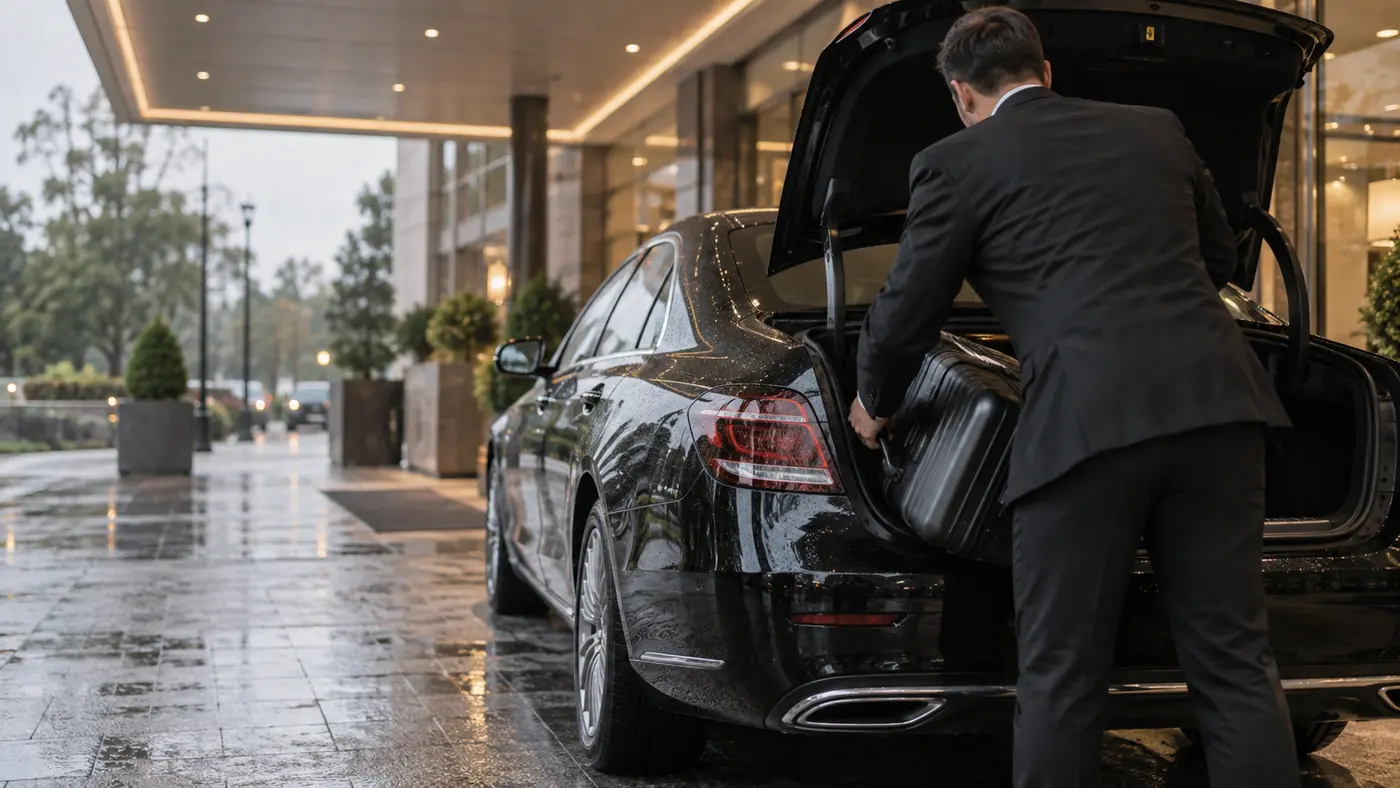
That is exactly what hotel transfers across Toronto are for: door to door, luggage handled, timed to checkout and check-in. Airport arrivals work the same way, with your flight number on the reservation so the pickup follows the actual landing. Obsidian Ride operates 24/7 dispatch across Toronto and the GTA.
From the airport to the right door.
Arrange your arrival from Pearson or Billy Bishop, or a transfer between hotels, with luggage handled at both ends.
Where to stay in Toronto: frequently asked questions.
What is the best area to stay in Toronto for first-time visitors?
Downtown, between the waterfront and Bloor Street, and ideally near Union Station or a Line 1 subway stop. Within that, the Financial and Entertainment districts put you closest to the waterfront, the CN Tower and the UP Express. St. Lawrence and Old Town suit travellers who want older streets and the market on their doorstep.
Where should I stay in Toronto for business?
The Financial District, for most business trips. It sits beside Union Station, connects to much of the core through the underground PATH network, and puts you within walking distance of the main office towers. Yorkville suits business travellers who want a quieter evening, with good subway access on Line 1 and Line 2.
Where should families stay in Toronto?
Harbourfront and the Financial District work well for families, with the waterfront, the CN Tower, the aquarium and the island ferry all within walking distance. Yorkville is a calmer alternative close to the Royal Ontario Museum. Avoid basing a family in the busiest nightlife streets of King West and the Entertainment District.
What is the best area in Toronto for food and nightlife?
King West and the Entertainment District for concentrated nightlife close to the core, and Queen West for independent restaurants, bars and a slightly more local feel. St. Lawrence is the better choice for food-focused travellers who prefer an early start at the market to a late night out.
Is it better to stay near Pearson Airport or downtown?
Downtown, for almost every trip longer than one night. An airport hotel makes sense for a single-night stopover, a very early flight, or a meeting near the airport. For sightseeing it leaves you a long journey from everything you came to see, and the saving rarely outweighs the travel time.
Is Yorkville a good place to stay in Toronto?
Yes, for travellers who want a quieter, more upscale base with boutiques, galleries and restaurants on the doorstep. It sits beside the Royal Ontario Museum and has good subway access on both main lines. The trade-off is distance from the waterfront, which is a subway ride rather than a walk.
What taxes are added to hotel bills in Toronto?
The City of Toronto's Municipal Accommodation Tax, which returned to 6% on 1 August 2026 after a temporary increase to 8.5%, plus HST. The accommodation tax applies to the room portion only and appears as a separate line on the invoice. Meals, parking and other services are excluded if itemised separately.
Are Airbnbs legal in Toronto?
Short-term rentals of under 28 days are legal in Toronto only in the host's principal residence, and hosts must register with the City. Entire-home rentals are capped at 180 nights a year, while rooms within a lived-in home have no annual cap. Listings in a host's investment property for short stays are not permitted.
How can I tell if a Toronto short-term rental is registered?
Look for the City of Toronto registration number, which hosts are required to display on their listing. Airbnb states that Toronto listings without a valid registration number or exemption are blocked from hosting stays of under 28 nights. A listing with no registration number is a reason for caution.
Which Toronto neighbourhoods are quietest at night?
Yorkville and the Annex are the calmest of the central areas, with residential streets and an earlier-evening atmosphere. The Distillery District and St. Lawrence are quieter than the Entertainment District. King West and Queen West are the liveliest at night, which suits some travellers and not others.
How do I get from Pearson Airport to my hotel?
For a hotel near Union Station, the UP Express reaches Union from Terminal 1 in about 28 minutes. For Yorkville or the Annex, a taxi, airport limousine or pre-arranged transfer is usually simpler than changing trains with luggage. For a split stay across two hotels, a booked transfer avoids carrying bags across the city.