
Flight Delayed at Pearson: What to Do, and What You’re Owed.
Under Canadian rules, what you are entitled to during a delay depends less on how long you wait than on why. This guide explains the test that decides it, the treatment and compensation that follow, what happens to connections, and what the person waiting at arrivals should do.
A departures board that reads "delayed" is almost useless as information. It tells you nothing about whether you will be fed, rebooked, housed overnight or paid, because in Canada none of those turn on the length of the wait alone.
They turn on a single question: was the cause within the airline's control? Everything in the regulations flows from the answer, which is why the reason given at the gate is worth more attention than the new departure time.
If your flight is delayed at Pearson, first establish the reason. For delays within the airline's control, you are owed food, drink and communication after two hours, accommodation if you wait overnight, and compensation of $125 to $1,000 depending on how late you arrive. For delays outside its control, the airline must still get you to your destination.
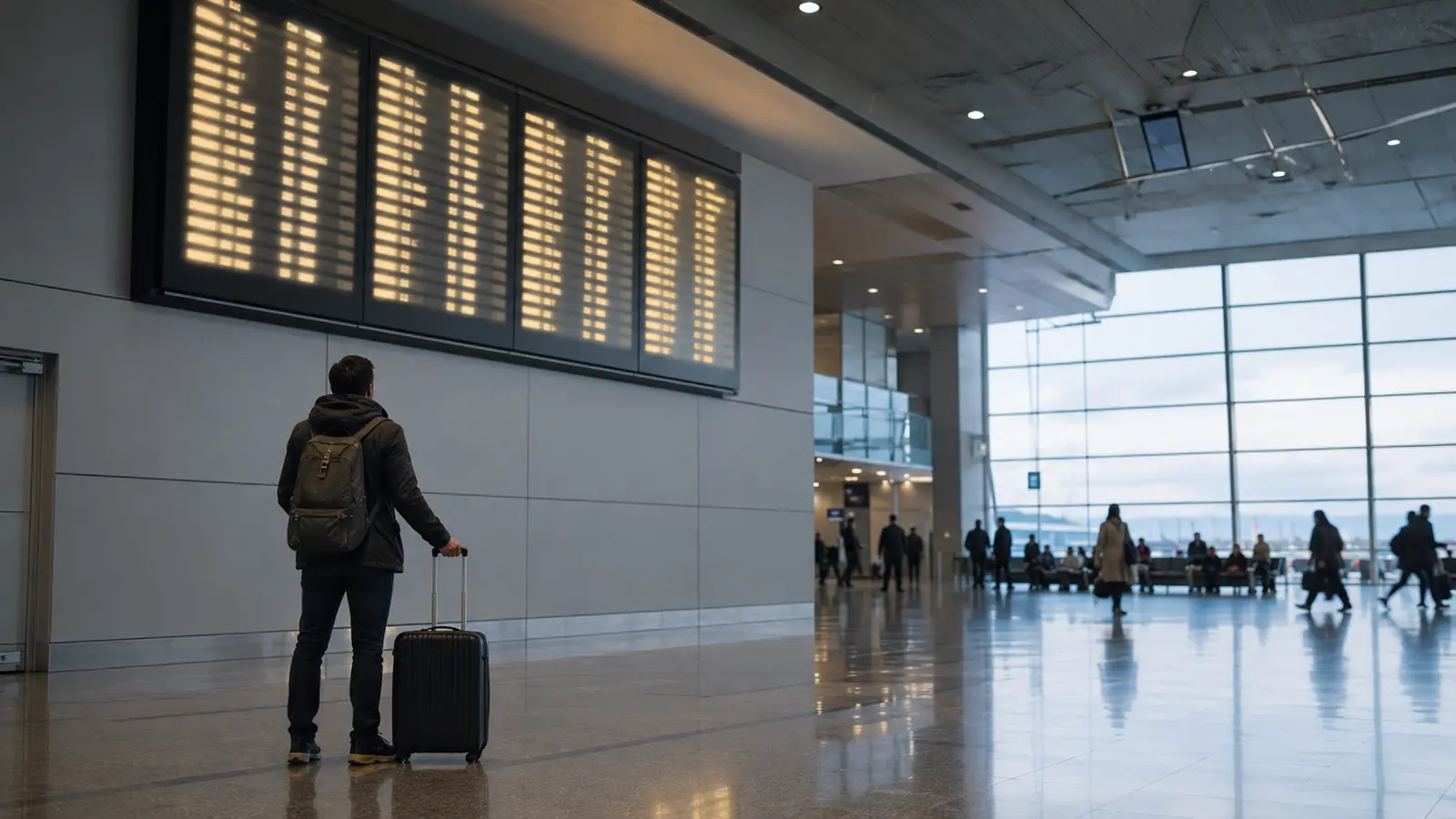
The first thing to do.
Get the reason, and get it recorded. Ask at the gate, check the app, and take a screenshot of whatever the airline puts in writing. Airlines are required to tell you why the flight was disrupted as soon as is feasible, so this is not an unreasonable request.
Why it matters so much: "crew scheduling" and "weather" sit in different categories and produce entirely different entitlements. If the stated reason later changes, having the original in writing is what makes a claim straightforward rather than contested.
Then, in order: check whether you have a connection at risk, join the rebooking queue early rather than waiting to see what happens, and tell whoever is meeting you before they set off.
How you’ll be told.
The communication rules are more prescriptive than most travellers realise. Airlines must inform you of the disruption through an audible announcement, a visible announcement on request, and the communication method you selected, such as email or SMS.
They must then provide status updates every 30 minutes until a new departure time is confirmed, and offer new information sooner if it becomes available. They must also tell you which standards of treatment and compensation apply, and about your recourse options including complaining to the regulator. Communication must be accessible, with digital formats compatible with adaptive technologies and paper alternatives available in large print, Braille or digital form on request.
Toronto Pearson runs its own channels alongside the airline's. You can set up SMS notifications from a flight's page on the airport site, and a gate tracker at flights.torontopearson.com is reachable directly or by scanning a QR code shown on check-in and gate screens. The airport's departures listing covers yesterday, today and tomorrow. You can also check the live status of your flight before leaving home.
The TestThe question that decides everything.
Canada's regulations sort every disruption into one of three categories, and your entitlements follow from which one applies. This is the part most guides skip, and it is the part that matters at the gate.
| Category | Typical examples | Treatment | Compensation |
|---|---|---|---|
| Within airline control | Commercial overbooking; scheduled maintenance required by law; a mechanical fault found during scheduled maintenance | Yes | Yes |
| Within control, required for safety | An unforeseen mechanical problem; a decision by the pilot or under the airline's safety management system | Yes | No |
| Outside airline control | Weather making safe operation impossible; air traffic control instructions; a security threat; a medical emergency; a bird strike; airport operations issues; a labour disruption; war or political instability | No | No |
In all three cases the airline must still ensure you complete your itinerary and reach your final destination. That obligation never disappears.
A distinction worth arguing. Scheduled maintenance, and mechanical problems identified during scheduled maintenance, sit in the first category and do pay. Unforeseen mechanical problems sit in the second and do not. "Mechanical" on its own is not an answer, and it is reasonable to ask which of the two it was.
What you’re owed during the wait.
Standards of treatment apply to departure delays within the airline's control, including those required for safety. They do not apply to delays outside its control, which is the single most common misunderstanding on this subject.
After a two-hour departure delay, the airline must provide:
- Food and drink in reasonable quantities
- A means of communication, such as free wifi
If you must wait overnight, it must offer hotel or comparable accommodation free of charge, together with free transport to and from it.
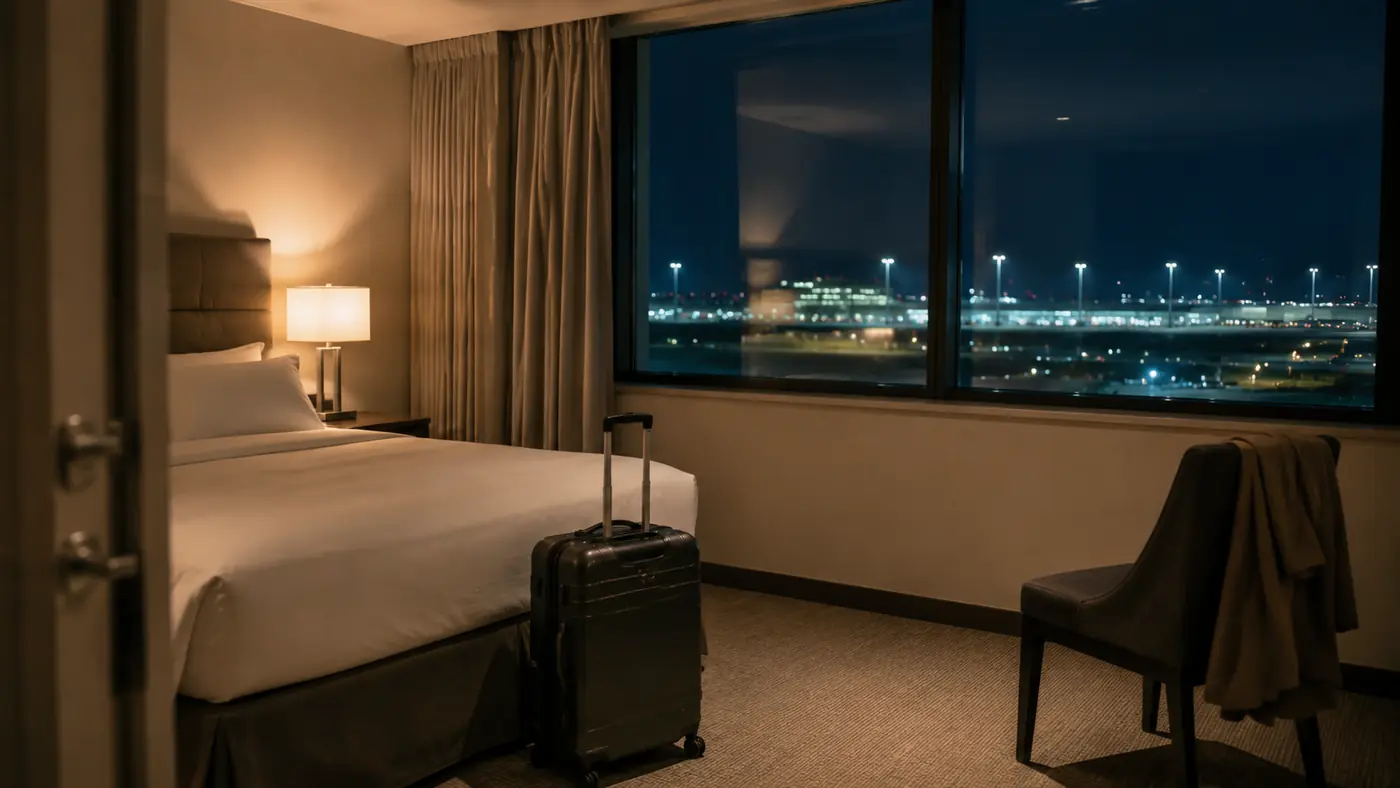
In practice the offer is often a voucher and a shuttle, and the hotel may be some distance from the airport. If you would rather stay somewhere specific, ask what the airline will reimburse before booking it yourself, and keep receipts. Getting into the city instead is a reasonable choice for a long overnight wait, and hotel transfers across the downtown core are straightforward to arrange.
CompensationCompensation.
Compensation is owed for delays and cancellations within the airline's control and not required for safety. Two details are frequently got wrong: the amount depends on how late you arrive at your final destination, not on how long the departure was delayed, and the figures differ by carrier size.
| Arrival delay | Large airlines | Small airlines |
|---|---|---|
| 3 to 6 hours | $400 | $125 |
| 6 to 9 hours | $700 | $250 |
| 9 hours or more | $1,000 | $500 |
Compensation must be offered in monetary form. An airline may also offer an alternative such as a voucher, but you always choose which you take, and any alternative must be worth more than the cash amount and must never expire. If you are offered a travel credit, you are entitled to decline it and take the money.
Rebooking and refunds.
Once a delay reaches three hours, or a flight is cancelled, the airline must offer alternative travel arrangements in the same class of service using a reasonable route. It must rebook you on its own next available flight or one operated by a commercial partner.
The thresholds that force a large carrier onto a competitor differ by category:
- Within the airline's control, whether or not safety-related: if its own or a partner's next flight would not leave within nine hours of the original departure time, a large carrier must book you on any airline, including a competitor.
- Outside the airline's control: the same obligation applies if no flight departs within 48 hours of the end of the event that caused the disruption.
- Another airport: if a large airline cannot rebook you from the same airport within 48 hours, it must book you from another nearby airport if one is available.
For disruptions other than those outside the airline's control, you may take a refund instead of a rebooking if the arrangements offered do not meet your travel needs, or if the trip no longer has a purpose. Taking the refund does not forfeit compensation: where the disruption was within the airline's control and not required for safety, large airlines must still pay $400 and small airlines $125.
One practical note if you are rebooked at Pearson: a different flight can mean a different building, so confirm which terminal your rebooked flight uses rather than assuming it leaves from where you are standing.
Tarmac delays.
If you are held on the aircraft, separate rules apply, and they are strict.
During any tarmac delay, in Canada or abroad, the airline must provide working lavatories, proper ventilation and heating or cooling, food and drink, and the ability to communicate with people outside the aircraft free of charge where feasible.
After three hours on the tarmac at a Canadian airport, the airline must return to the gate so passengers can disembark. One narrow extension exists: the aircraft may remain up to 45 further minutes if take-off is likely within that window and the required standards of treatment continue. Beyond that, the aircraft must return to the gate, unless prevented for reasons of safety, security, customs or air traffic control.
Connections.
The regulations apply to connecting flights, and the airline's duty to ensure you complete your itinerary runs to your final destination rather than to the next airport.
That has a useful consequence. Because compensation is measured by arrival delay at the final destination, a 90-minute delay leaving Pearson that causes you to miss a connection and arrive ten hours late can carry the full entitlement, even though the original delay was well under three hours.
If you are connecting through Pearson rather than starting here, ask at the transfer desk rather than the gate, and check whether your checked bags have been re-tagged. If they have gone astray as well, our guide on what to do if your bag doesn't arrive either covers that side of it.
Denied boarding pays differently.
Worth knowing because delays and overbooking often coincide. Denied boarding happens when you hold a valid ticket but no seat is available. The amounts are substantially higher than delay compensation and the bands start earlier.
| Length of delay | Amount (CAD) |
|---|---|
| 0 to 6 hours | $900 |
| 6 to 9 hours | $1,800 |
| 9 hours or more | $2,400 |
Before denying boarding for reasons within its control, an airline must seek volunteers, and must put the agreed benefits in writing before the flight departs. Compensation is payable when you are notified, or within 48 hours if payment cannot be made before your new departure time, and can be topped up if your actual delay proves longer than expected. Rebooking and treatment obligations then apply as for any delay.
How to claim afterwards.
Very few people claim, largely because the window is longer than they assume and the moment passes.
- You have one year from the disruption to claim with the airline that operated the flight.
- Claim in writing, with flight number, date, route, the stated reason and your actual arrival time at the final destination.
- The airline has 30 days to respond, either by paying or by explaining why it believes compensation is not owed.
- Escalate if needed. Airlines must tell you about your recourse options, and unresolved disputes can go to the Canadian Transportation Agency's air passenger protection service.
You do not need to pay anyone a percentage to file on your behalf. The claim is a form and a paragraph, and the regulations put the burden on the airline to explain a refusal.
UpdateThe reform that hasn’t landed yet.
You will find articles describing a different, simpler Canadian regime in the present tense. Treat them carefully.
Parliament amended the Canada Transportation Act in June 2023 to eliminate the three categories and require airlines to compensate passengers for any disruption unless they can prove clearly defined exceptional circumstances. But the Canadian Transportation Agency must still amend the regulations to give effect to that, and its published guidance continues to set out the three-category regime described above.
Where that leaves you. The rules in this guide are the ones the regulator currently publishes. The reform would shift the burden of proof onto airlines and simplify eligibility, which would make claiming easier. Before relying on either version, check the CTA's air passenger protection pages for the position on the day you travel.
If you’re the one waiting at arrivals.
Half the people reading this are not on the aircraft. If you are collecting someone, the useful guidance is different.
- Track the aircraft, not the schedule. A published arrival time updates slowly; the inbound aircraft's actual position does not.
- Add the exit time, not just the landing time. Deplaning, walking, border processing and baggage all sit between wheels-down and the arrivals door, and international arrivals can take considerably longer than domestic.
- Do not wait on the terminal roadways. Pearson's free cell phone waiting area exists precisely for this, and the Express Pass gives a short free window in the garages. Curbside waiting is not permitted.
- Agree a meeting point in advance, because a rebooked flight can arrive at a different terminal from the one you planned for. Our guide to where each vehicle type meets you covers both.
- Ask them to text once through customs, not once they land. Those are different moments and often an hour apart.
If you are dropping someone off rather than collecting, the timing question runs the other way, and how early to arrive at Pearson sets out the buffers by flight type.
Six mistakes that cost people money.
- Not getting the reason in writing. The stated cause is the whole basis of a claim.
- Accepting a voucher without asking. Compensation must be offered in cash, and the choice is yours.
- Measuring the delay at departure. The clock that matters is arrival at your final destination.
- Waiting to see what happens. Rebooking options thin out while the queue grows.
- Assuming treatment applies to every delay. Food, drink and hotels are owed for delays within the airline's control, not outside it.
- Never claiming. You have a full year, and the airline must answer within 30 days.
Pickups that follow the aircraft.
A delay creates one logistical problem that no regulation addresses: the car booked against a schedule that no longer exists.
This is where a pre-arranged transfer behaves differently from a walk-up option. When your flight number is on the reservation, the arrival is monitored and dispatch works from the actual landing rather than the printed time. Obsidian Ride operates 24/7 dispatch with real-time flight tracking and includes complimentary wait time on airport pickups.

Two things still help on your side. Put the flight number on the booking rather than only a time, and send a message if you are rebooked onto a different flight, since a new flight number is new information that no tracking system can infer. Full details are on the Pearson Airport chauffeur service page.
One less thing to rearrange.
Add your flight number to the reservation and the pickup is planned around the aircraft, so a delay changes your evening rather than your ground transport.
Flight delayed at Pearson: frequently asked questions.
What should you do first if your flight is delayed at Pearson?
Find out the reason for the delay and get it in writing or in the app. Under Canadian rules your entitlements depend entirely on whether the cause was within the airline's control, so the stated reason matters more than the length of the wait. Then confirm your rebooking options before the queue at the service desk builds.
How will the airline tell me my flight is delayed?
Airlines must tell you why as soon as feasible, through an audible announcement, a visible announcement on request, and whichever communication method you selected, such as email or SMS. They must then provide status updates every 30 minutes until a new departure time is confirmed. Toronto Pearson also offers its own SMS notifications and a gate tracker.
How much compensation can you get for a delayed flight in Canada?
For delays within the airline's control and not required for safety, large airlines pay $400 for a 3 to 6 hour arrival delay, $700 for 6 to 9 hours and $1,000 for 9 hours or more. Small airlines pay $125, $250 and $500. Compensation is based on how late you arrive at your final destination, not on departure delay.
What is the airline required to give you during a delay?
After a two-hour departure delay within the airline's control, including delays required for safety, it must provide food and drink in reasonable quantities and a means of communication such as free wifi. If you have to wait overnight, it must offer hotel or comparable accommodation free of charge, plus free transport to it.
Does the airline have to rebook me on a competitor?
Sometimes. If the disruption is within the airline's control and its own next available flight, or a partner's, would not leave within nine hours of the original departure time, a large carrier must rebook you on any airline. For disruptions outside its control, that obligation applies at 48 hours instead.
Can I get a refund instead of being rebooked?
Yes, for disruptions other than those outside the airline's control, if the alternative arrangements do not meet your travel needs or the trip no longer has a purpose. If the disruption was within the airline's control and not required for safety, taking the refund does not cancel your compensation: large airlines must still pay $400 and small airlines $125.
How long can a plane sit on the tarmac at a Canadian airport?
Three hours, with one narrow extension. After a three-hour tarmac delay at a Canadian airport the airline must return to the gate so passengers can disembark, though the aircraft may stay up to 45 minutes longer if take-off is likely within that window and standards of treatment continue. Safety, security, customs or air traffic control can override this.
What happens to my connecting flight if the first leg is delayed?
The regulations apply to connecting flights, and the airline must ensure you complete your itinerary to your final destination. Compensation is calculated on your arrival delay at that final destination rather than at the connection point, which is why a short first-leg delay can still produce a large entitlement if it costs you a connection.
How long do I have to claim compensation for a delayed flight?
One year from the disruption to make a claim with the airline that operated the flight. The airline then has 30 days to respond, either by paying or by explaining why it believes compensation is not owed. Claim in writing, quote your flight number and date, and keep a copy of everything you send.
Are Canada's flight delay rules changing?
A reform is underway but is not yet in force. Parliament amended the Canada Transportation Act in June 2023 to remove the three-category system and require compensation unless an airline proves exceptional circumstances, and the Canadian Transportation Agency must still amend the regulations to reflect that. Until it does, the existing rules apply. Check the CTA before relying on either version.
What happens to my airport pickup if my flight is delayed?
With a pre-arranged transfer your flight number sits on the reservation and the arrival is monitored, so the pickup time moves with the actual landing rather than the schedule. Obsidian Ride operates 24/7 dispatch and includes complimentary wait time on airport pickups. A walk-up option gives you no equivalent flexibility.