
Pearson Security Wait Times: What Travellers Should Know
Screening at Toronto Pearson is usually quicker than travellers expect, but it swings sharply by hour, by terminal and by season. This guide explains what a posted wait figure actually measures, when the checkpoints are busiest, and how to translate either into a sensible time to leave home.
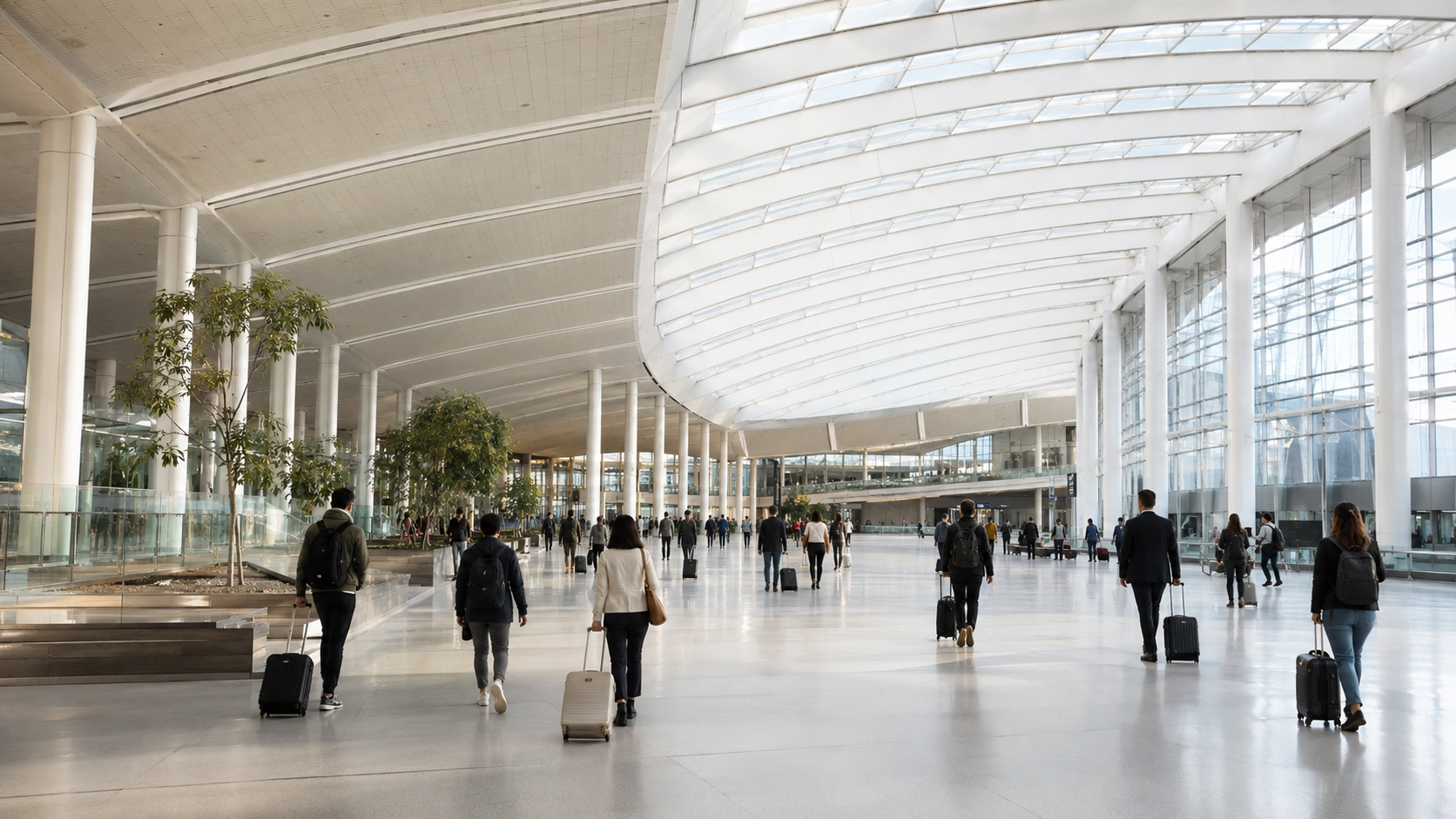
Pearson security wait times at Toronto Pearson International Airport typically run in the single digits to about twenty minutes outside peak periods, and can stretch considerably longer during the airport’s busiest departure banks and holiday weekends. The figure that matters to you is not an average. It is the wait at your specific terminal, on your specific morning, at the hour your flight departs.
That is why two travellers can leave the same neighbourhood on the same day and have completely different experiences at the checkpoint. One arrives during a lull between airline banks and walks through. The other arrives forty minutes later, during a wave of simultaneous departures, and waits four times as long. Nothing about the airport changed. Only the timing did.
Quick answer
Outside peak periods, screening at Pearson often takes ten to twenty minutes. The Canadian Air Transport Security Authority (CATSA) works to a published national service standard of screening 85 per cent of passengers within 15 minutes or less. Peaks cluster around the pre-dawn departure bank, the late-morning transborder push and the early-evening international bank. Check the estimated wait on Toronto Pearson’s official website before you leave home, then add curb-to-checkpoint walking time, check-in and bag drop on top of the screening estimate.
Screening rules, checkpoint layouts and reservation programmes at Canadian airports have been changing as new scanning equipment is deployed. Treat the patterns in this guide as planning guidance and confirm current requirements with CATSA and Toronto Pearson close to your travel date.
What a posted wait time actually measures
A posted or estimated security wait time measures one thing: the interval between joining the queue at a screening checkpoint and reaching the point where your belongings go onto the belt. It does not include check-in. It does not include bag drop. It does not include the walk from the kerb, the walk from the parking garage, or the walk from your gate’s pier back to the terminal core if you have gone the wrong way.
This distinction matters more than any single number, because travellers who miss flights at Pearson rarely miss them by an hour. They miss them by twelve minutes, having budgeted for the screening estimate alone.
The CATSA service standard
Screening at Canadian airports is carried out by CATSA, a federal Crown corporation, and by the screening contractors it engages. CATSA operates to a national service standard of screening 85 per cent of passengers in 15 minutes or less. Two things follow from that wording, and both are worth internalising.
First, it is a target across the passenger population, not a guarantee for any individual. Second, the remaining 15 per cent are not a rounding error. On a day when Pearson processes tens of thousands of departing passengers, that share represents a substantial number of people waiting longer than a quarter of an hour, and those people are heavily concentrated in the peak windows described below.
Screening time is not your arrival buffer
Your arrival buffer is the total time between reaching the terminal and your scheduled departure. Screening is one component of it. A useful way to think about the sequence is as four separate clocks running in order: getting from the kerb into the terminal, completing check-in or bag drop, clearing screening, and walking to the gate. Pearson’s piers are long, and a gate at the far end of a Terminal 1 pier can be a genuine ten-minute walk from the checkpoint exit.
If you want the full buffer calculation rather than the screening component alone, our guide on how early to arrive at Pearson works through it by flight type.
Before you travelWhere to check conditions before you leave
Toronto Pearson publishes estimated security screening wait times on its official website and mobile app, broken out by terminal and by checkpoint. This is the authoritative source. Third-party aggregators and crowd-sourced apps sometimes lag the airport’s own data or blend historical averages into a figure presented as live.
A sensible routine before any Pearson departure looks like this:
- Confirm your terminal directly with your airline. Terminal assignments can change, and a small number of carriers have moved between terminals in recent years.
- Check your flight status for delays before you leave, not after you arrive. A two-hour delay changes your entire plan.
- Look at the estimated screening wait on Toronto Pearson’s official site, and treat it as a snapshot rather than a forecast.
- Check road conditions on your route, particularly Highway 401 and Highway 427, which have their own independent peaks.
Pearson has also operated a free timed security reservation option that allows eligible departing passengers to book a slot at a checkpoint in advance. Availability, eligibility and the terminals covered have varied. If a reserved slot would meaningfully reduce your stress, check the airport’s current departures information before your travel date rather than assuming it is available for your flight.
TerminalsTerminal 1 and Terminal 3 checkpoints
Pearson has two active passenger terminals, and they behave differently. Terminal 1 is the larger facility and handles Air Canada and most Star Alliance partners along with a substantial international programme. Terminal 3 handles a mix of carriers including WestJet and several international and leisure airlines.
The practical differences for a departing passenger are less about which terminal is intrinsically faster and more about three things: how far your check-in area is from the screening checkpoint, which checkpoint your flight type routes you to, and how many flights are departing in the same window as yours. Terminal 1’s scale means the distances are longer; Terminal 3 is more compact but has less absorptive capacity when a wave arrives at once.
Each terminal separates its screening flows by destination type: domestic flights, international flights and US-bound flights follow different paths after check-in, and US-bound passengers go through American preclearance rather than a standard domestic checkpoint. If you are unfamiliar with the layout, our comparison of how Terminal 1 and Terminal 3 differ covers the orientation in more detail.
At a glanceWhen Pearson security is busiest
Pearson’s traffic is not evenly distributed across the day. Airlines schedule departures in banks, so that connecting passengers can be gathered and dispatched efficiently. Those banks are the single biggest driver of checkpoint congestion, and they are reasonably predictable.
| Window | Typical pressure | Why it happens |
|---|---|---|
| 04:00 – 07:00 | High | The first departure bank of the day. Almost everyone arrives within a compressed window because there is no earlier flight to have taken. |
| 07:00 – 09:00 | Moderate | The first wave has cleared; the next has not fully formed. |
| 09:00 – 12:00 | Moderate to high | Late-morning domestic and transborder departures, plus business travellers on same-day return itineraries. |
| 12:00 – 15:00 | Variable | Often the calmest sustained stretch of a weekday, though not on Fridays or Sundays. |
| 15:00 – 19:00 | High | The long-haul international bank builds. Passengers with checked luggage and no prior familiarity with the terminal concentrate here. |
| 19:00 – 23:00 | Moderate, then light | Late domestic departures taper through the evening. |
The seasonal pattern
Layered on top of the daily rhythm is a seasonal one. The heaviest sustained periods at Pearson are the March break window, the summer months from late June through August, and the two-week stretch around the December holidays. Long weekends produce sharp two-day spikes rather than sustained pressure, with the outbound surge on the Thursday evening and Friday morning and the return surge on the Monday.
Winter adds a different complication. A snow event does not usually lengthen the security queue directly, but it lengthens your drive, delays de-icing, and can push a cancelled flight’s passengers into the next morning’s bank, which then runs heavier than normal.
PreparationWhat actually slows the line down
Checkpoint throughput depends heavily on how prepared passengers are when they reach the belt. A single bag that requires a secondary search can hold up a lane for several minutes. Multiply that across a peak window and the effect on the posted wait is significant.
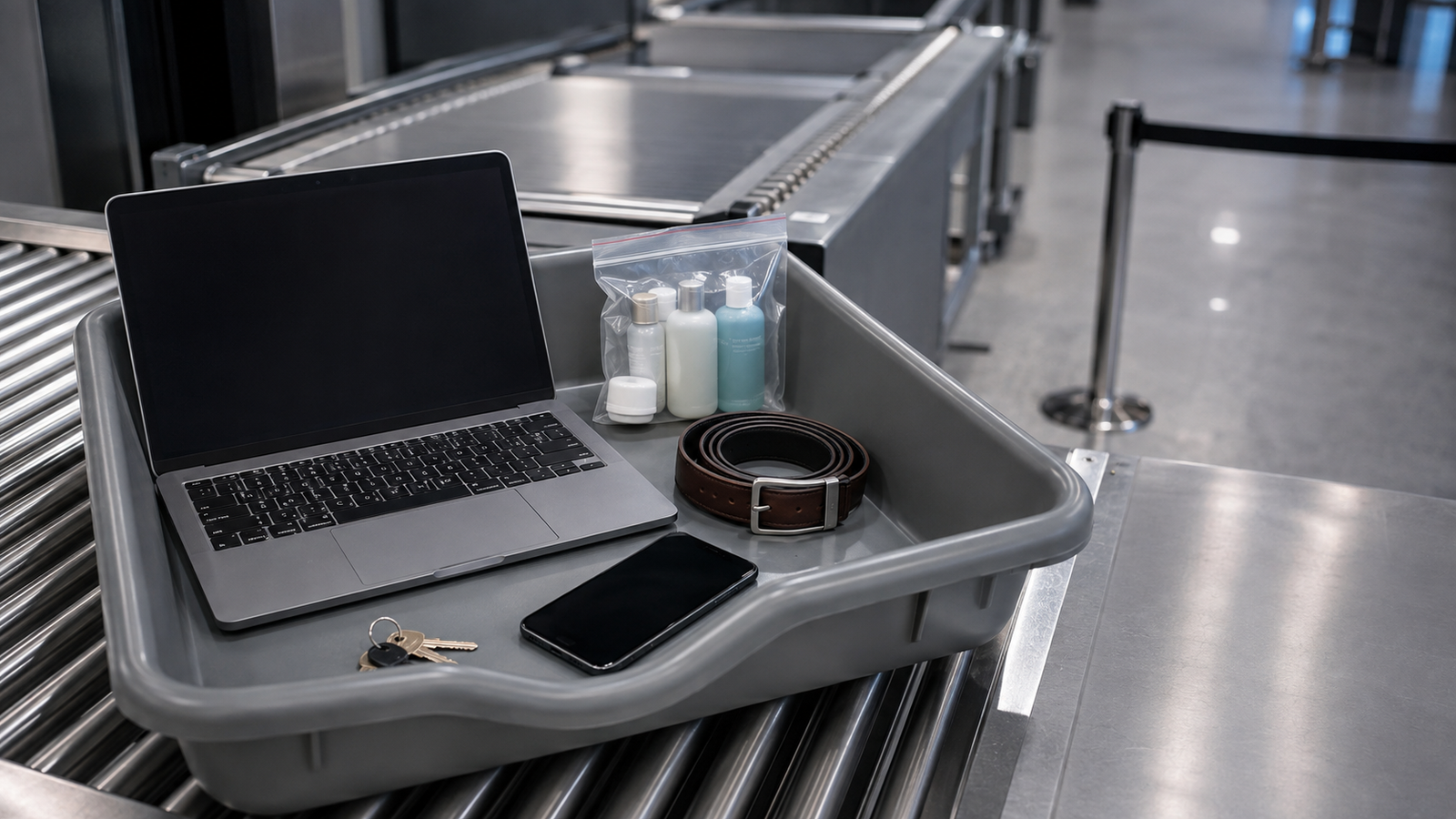
The items that most often trigger a secondary search are ordinary rather than exotic: a full water bottle, an oversized toiletry container, a power bank buried at the bottom of a backpack, or a densely packed bag that the scanner cannot read cleanly.
- Confirm the current liquids and gels rules with CATSA before you pack. Requirements have been changing at Canadian airports as new computed-tomography scanners are introduced, and they are not uniform across every checkpoint.
- Empty your water bottle before joining the queue, not at the belt.
- Keep power banks and spare lithium batteries in your carry-on and near the top, where you can reach them.
- Have your boarding pass ready at the entrance to the queue, on paper or on a screen with the brightness turned up.
- Remove outerwear, belts and metal items while you are still waiting, so you are not doing it at the tray.
- Do not pack a carry-on to absolute capacity. A bag that must be repacked after inspection costs you far more time than the space saved.
- If you are travelling with children, allow extra time regardless of the posted wait; the divestment process simply takes longer with a family.
CATSA maintains a searchable tool for individual items, which is more reliable than memory or a friend’s recollection of a previous trip. Check it at catsa-acsta.gc.ca if you are carrying anything unusual.
Faster lanes and who qualifies
Not every passenger uses the same queue. Pearson operates dedicated lanes that can materially reduce your wait if you qualify.
NEXUS members have access to dedicated screening lanes at Canadian airports, including Pearson. The programme is a joint Canada–United States trusted traveller arrangement and requires an application, a fee and an interview. For anyone flying out of Pearson more than a few times a year, particularly on transborder routes, it is the single most effective way to reduce time at the airport.
Families and passengers requiring assistance are directed to a separate line at Canadian checkpoints, designed to give more space and time for divestment without pressure from the queue behind. If you are travelling with young children, a stroller, or mobility equipment, ask a screening officer at the entrance rather than joining the general queue by default.
Premium cabin and elite status passengers may be offered expedited access by some airlines. This is an airline benefit rather than a CATSA one, so eligibility varies by carrier and by fare. Check with your airline rather than assuming.
US departuresUS preclearance is a different process
If you are flying from Pearson to the United States, you do not simply clear security. You clear United States Customs and Border Protection inside the Canadian terminal, before you board. This is preclearance, and it means you arrive in the US as a domestic passenger.
Preclearance is genuinely useful on arrival, because it removes the immigration queue at the far end. It also means your pre-departure timeline is longer, because you are completing two processes rather than one: an American border inspection and a security screening. Passport control questions, biometric processing and the occasional secondary inspection all sit inside that window.
Treat preclearance as its own budget item rather than folding it into a general security estimate. Posted security wait times for domestic checkpoints do not describe the preclearance queue. Background on the programme is available from US Customs and Border Protection.
Turning a wait time into a leave-home time
This is the calculation most travellers actually want, and it runs backwards from the flight rather than forwards from the front door. Work through it in four steps.
- Start with your scheduled departure time. Not the boarding time on your pass.
- Subtract your airline’s recommended arrival window for your flight type. This is the airline’s figure, and it accounts for check-in and bag drop closing times, which are stricter than most travellers realise.
- Subtract the drive time, using a pessimistic estimate. Take the longer end of any range you are given, then add a margin for the 401 or 427.
- Add a fixed contingency of fifteen to thirty minutes depending on the season, the hour and whether you are checking bags.
| Flight type | Processes before the gate | Where the time usually goes |
|---|---|---|
| Domestic | Check-in or bag drop, security screening, walk to gate | Shortest overall sequence. The main risks are bag-drop cut-offs and long pier walks. |
| Transborder (US) | Check-in or bag drop, US preclearance, security screening, walk to gate | Two inspection processes rather than one. Budget the most conservative timeline of the three. |
| International | Check-in and bag drop, security screening, walk to gate | Check-in itself is often the bottleneck, particularly during the late-afternoon bank with heavy checked luggage. |
Confirm the arrival window with your own airline rather than relying on a general rule. Carriers publish their own check-in and bag-drop cut-off times, and they differ.
TransportationGetting to Pearson: the honest comparison
How you travel to the airport determines the reliability of the one variable you fully control. Each option suits a different traveller, and none is universally correct.
| Option | Strengths | Limitations | Best for |
|---|---|---|---|
| UP Express | Fixed journey time from Union Station, unaffected by road traffic | Requires getting to Union first; limited luggage handling; service hours do not cover every flight | Downtown travellers with light luggage and mid-day flights |
| TTC and regional transit | Lowest cost; extensive coverage across the GTA | Longest journey; transfers with luggage; reduced overnight service | Budget-conscious solo travellers without checked bags |
| Taxi | Available on demand; familiar; no advance planning | Availability varies at pre-dawn hours in outer suburbs; vehicle size not guaranteed | Short-notice trips from central areas |
| Rideshare | Convenient; transparent app-based pricing | Surge pricing during peak periods; vehicle and luggage capacity unknown until arrival; cancellations possible | Flexible travellers with modest luggage |
| Driving and parking | Full control over departure time; useful for short trips | Parking cost accumulates; garage-to-terminal walk adds time; return trip after a long flight | Short trips and travellers with easy highway access |
| Pre-arranged chauffeur | Fixed pickup time; vehicle matched to passengers and luggage; door-to-door | Requires booking in advance | Early departures, families, groups, corporate schedules and travellers with significant luggage |
Schedules and service hours for rail and transit change. Confirm current information directly with UP Express or the TTC before relying on either for an early-morning flight.
Where Obsidian Ride fits
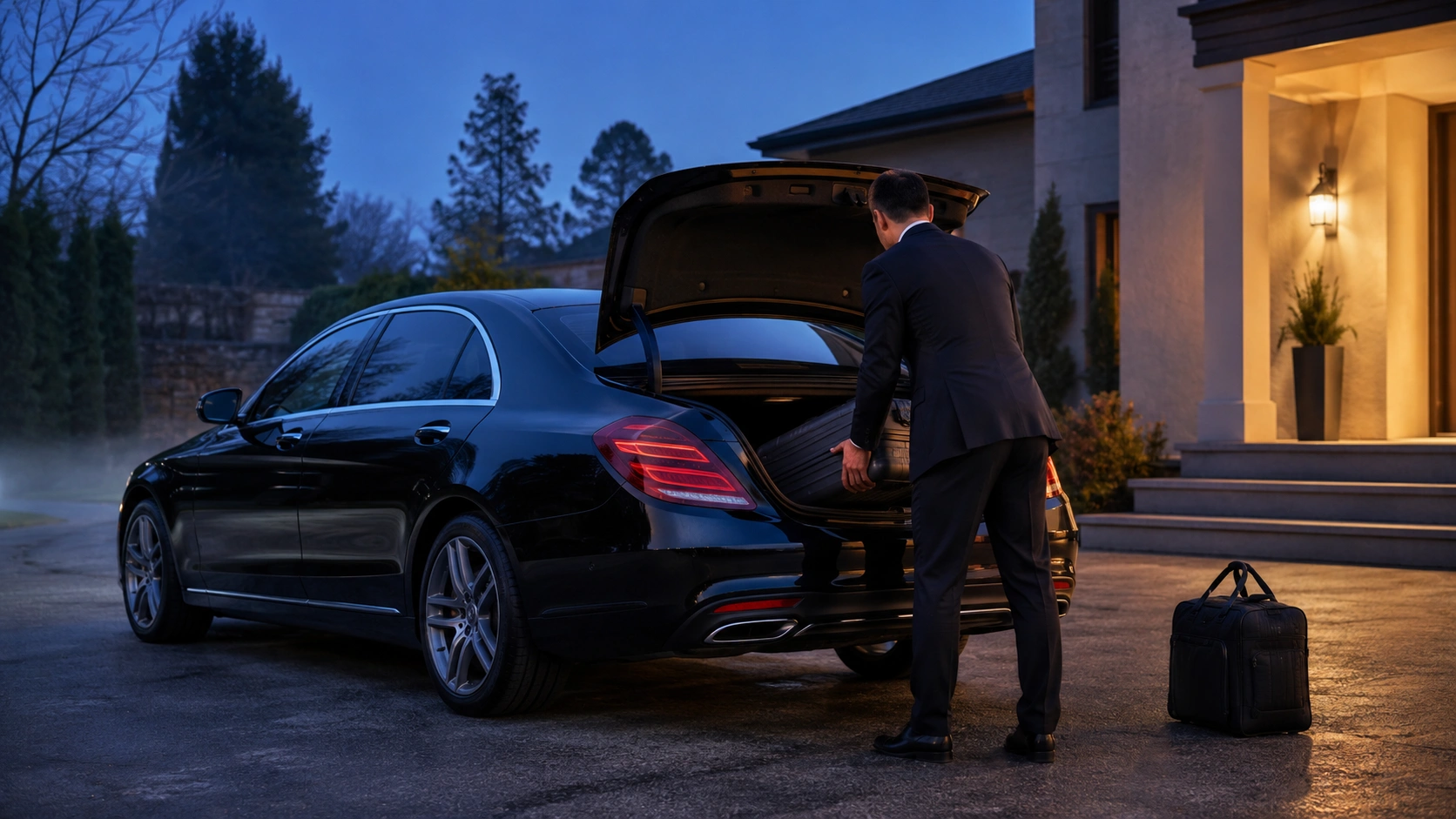
The value of a pre-arranged transfer in the context of security wait times is narrow and specific: it makes the front end of your timeline a decision rather than a variable. You choose the pickup time based on your terminal, your flight type and the peak window you are trying to avoid, and that time is set in advance rather than negotiated with an app at five in the morning.
Obsidian Ride is a private chauffeur and executive transportation company serving Toronto and the Greater Toronto Area. For departures, that generally means a pre-arranged Pearson airport transfer from a home, office or hotel, with the vehicle selected for the number of passengers and the amount of luggage travelling.
The scenarios where this tends to matter most are the predictable ones. A 6 a.m. international departure that requires leaving a Mississauga or Oakville address before four. A family of five with checked bags who will not fit comfortably in a standard sedan. A corporate group heading to the same flight from different offices. A long-haul departure during the late-afternoon bank, when both the highways and the checkpoints are under pressure at once.
If luggage capacity is your constraint, the vehicle and luggage capacity details are worth reviewing before booking. Organisations that move executives through Pearson regularly can arrange corporate travel programmes, and travellers with needs beyond the airport can review chauffeur service across Toronto.
QuestionsFrequently asked questions
How long does security take at Toronto Pearson?
Outside peak periods, screening at Pearson commonly takes ten to twenty minutes. CATSA works to a national standard of screening 85 per cent of passengers in 15 minutes or less. During the pre-dawn bank, the late-afternoon international bank and holiday periods, waits can be considerably longer. Check the estimated wait for your terminal on Toronto Pearson’s official website before leaving home.
What time is Pearson airport busiest?
The heaviest windows are roughly 4 a.m. to 7 a.m., when the first departure bank of the day departs, and roughly 3 p.m. to 7 p.m., when long-haul international flights build. Late morning is moderately busy with domestic and transborder departures. Early afternoon on a mid-week day is usually the calmest sustained stretch.
Can I check Pearson security wait times before I leave?
Yes. Toronto Pearson publishes estimated screening wait times by terminal and checkpoint on its official website and mobile app. Treat the figure as a snapshot of current conditions rather than a forecast for when you will arrive, and check your flight status at the same time so a delay does not undo your plan.
Is Terminal 1 or Terminal 3 faster for security?
Neither terminal is reliably faster. Terminal 1 is larger with more capacity but longer internal distances; Terminal 3 is more compact but has less room to absorb a sudden wave. What matters more is the hour you arrive, your flight type and how many departures share your window. Confirm your terminal with your airline before travelling.
Does NEXUS have a separate security line at Pearson?
Yes. NEXUS members have access to dedicated screening lanes at Canadian airports, including Toronto Pearson. NEXUS is a joint Canada–United States trusted traveller programme requiring an application, a fee and an interview. For frequent Pearson departures, particularly on US routes, it is the most effective way to reduce time spent in queues.
Do I still need to take my laptop out at Pearson?
It depends on the equipment at your checkpoint. Newer computed-tomography scanners can screen bags without removing electronics, but deployment is not uniform across every lane. Follow the instructions given by the screening officer at your checkpoint, and check CATSA’s current guidance before you pack if you want to know in advance.
How long should I allow for US preclearance at Pearson?
Allow more time than for a domestic departure. US-bound passengers clear American border inspection inside the Canadian terminal in addition to security screening, so two processes run before boarding. Posted security wait times do not describe the preclearance queue. Confirm your airline’s recommended arrival window for transborder flights, which is typically the longest of the three flight types.
What time should I leave home for an early flight from Pearson?
Work backwards rather than forwards. Start at your scheduled departure, subtract your airline’s recommended arrival window, subtract a pessimistic drive estimate, then add fifteen to thirty minutes of contingency. Early-morning flights fall inside the day’s heaviest screening window, so a pre-arranged pickup removes the uncertainty of finding a vehicle before dawn.
Set your pickup time around the checkpoint
Tell us your flight, your terminal and how much luggage is travelling, and we will arrange a pickup time that accounts for the departure window you are flying in.