
Pearson to Financial District: Every Route, Honestly Compared.
The journey itself is straightforward. What catches travellers out is the last mile: the train ends at Union Station, and the Financial District runs north from there for several blocks. This guide compares the four routes and sets out a realistic time budget from wheels-down to a meeting.
Getting from Pearson to Financial District addresses is one of the most routine journeys in Toronto, and one of the easiest to misjudge. The route options are well signposted and the train is genuinely good. The problem is that most planning stops at Union Station, and Union Station is not where the meeting is.
So this guide covers the four routes honestly, then spends as much time on the last mile and the time budget as on the journey itself.
The UP Express runs from Terminal 1 to Union Station in about 28 minutes, every 15 minutes, and is usually the fastest option for a traveller with a cabin bag. Licensed taxis, airport limousines, ride-share and pre-arranged private transfers all go door to door instead, which matters if your building is a walk from Union or you are carrying luggage.
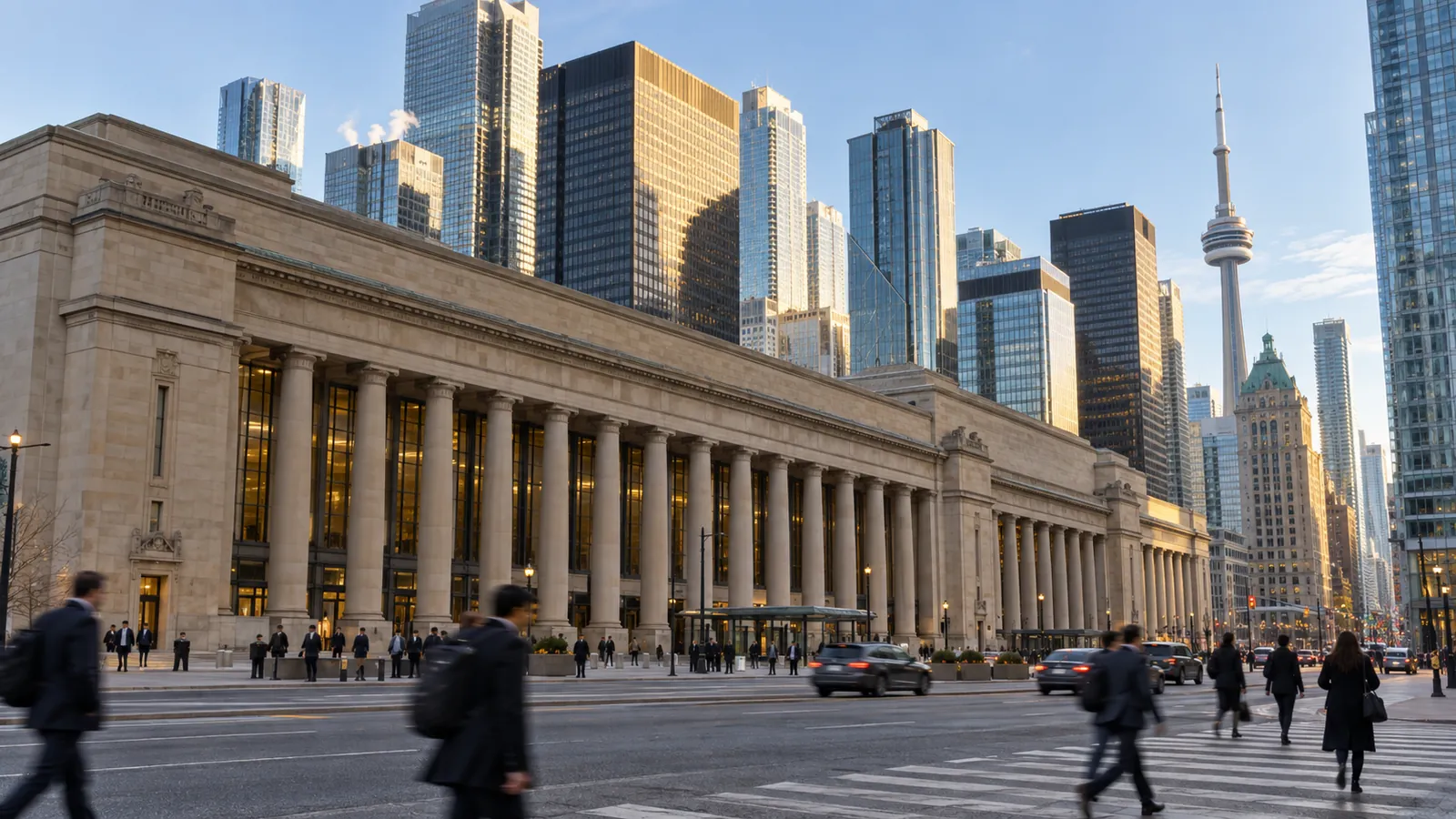
Where the Financial District actually is.
Toronto's Financial District runs north from Front Street toward Queen Street, centred on Bay Street and spreading a few blocks either side of it. Union Station sits at 65 Front Street West, on the southern boundary.
That geography has a practical consequence that almost every route guide skips. If your meeting is in a tower near Front and Bay, the train has effectively delivered you to the door. If it is up near Adelaide or Queen, you have a further walk of roughly ten to fifteen minutes, or a short subway hop on Line 1.
Before you choose a route, find out two things about your destination: the nearest cross-streets, and whether the building connects to the PATH. Those two facts decide whether the train is the fastest option or merely the cheapest one.
If your trip includes meetings outside the core as well, our guide to how Toronto's business districts fit together covers the wider corridors, several of which the train does not usefully serve at all.
At a GlanceThe four routes.
| Route | Ends at | Luggage | Best for |
|---|---|---|---|
| UP Express | Union Station, then walk or PATH | Carry it yourself, on and off the train | Light travellers with a destination near Union or on the PATH |
| Licensed taxi or airport limousine | Your building | Handled, boot space | Walk-up convenience without app pricing |
| Ride-share | Your building | Handled, boot space | One or two bags, off-peak arrivals |
| Pre-arranged private transfer | Your building, at a known time | Handled; bags can stay in the vehicle | Fixed meetings, groups, luggage, late arrivals |
For a good number of readers, the honest answer is the train. If you are travelling with a cabin bag to an office near Union Station, nothing else is faster or simpler. The case for the other three grows with luggage, group size, distance from Union and the rigidity of your schedule.
By TrainThe UP Express.
The UP Express connects Pearson to Union Station in about 28 minutes, with trains every 15 minutes. It is a dedicated air-rail link rather than a commuter service, with luggage racks and a predictable journey time regardless of traffic.
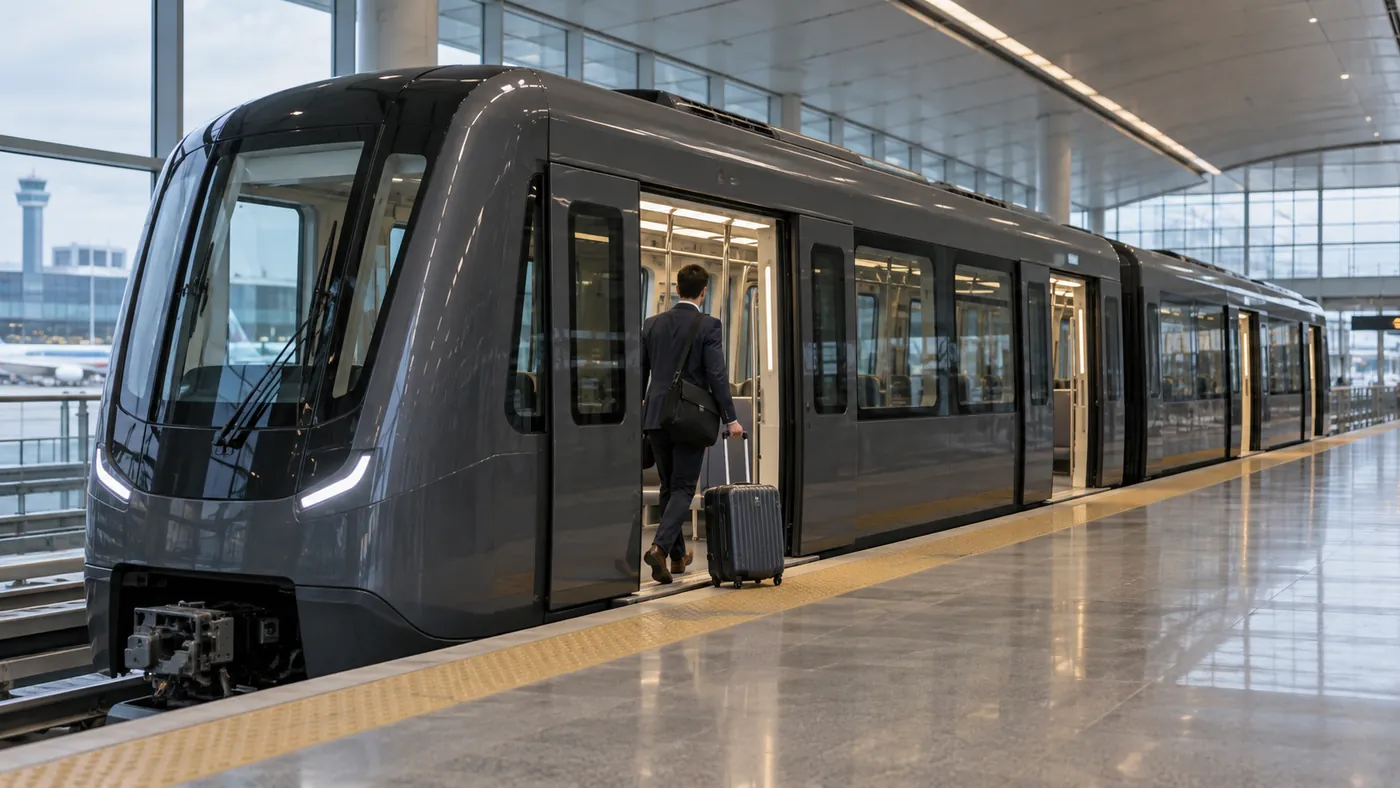
Getting to the platform
The station is at Terminal 1 only. If you land at Terminal 1, it is a walk from the arrivals level to the platform. If you land at Terminal 3, you first take the free Terminal Link train, which runs around the clock between Terminal 1, Terminal 3 and Viscount Station, then walk to the UP Express platform.
This is the most common planning error on this route. Guides routinely say "take the UP Express from Pearson" without qualification. A Terminal 3 arrival should add the Terminal Link ride and the walk at both ends to the journey time. Check which terminal you land in before assuming a 28-minute trip.
What it costs you in time
The 28 minutes is the rail segment. A realistic door-to-door figure adds the walk to the platform, any wait for the next departure, and the last mile at the Union end. For a Terminal 1 arrival to a building close to Union, that is still comfortably the quickest option. For a Terminal 3 arrival to a building near Queen Street, the advantage narrows considerably.
The Last MileThe last mile from Union.
At Union, the UP Express platform sits within the interior SkyWalk walkway. From there you have three ways into the district.
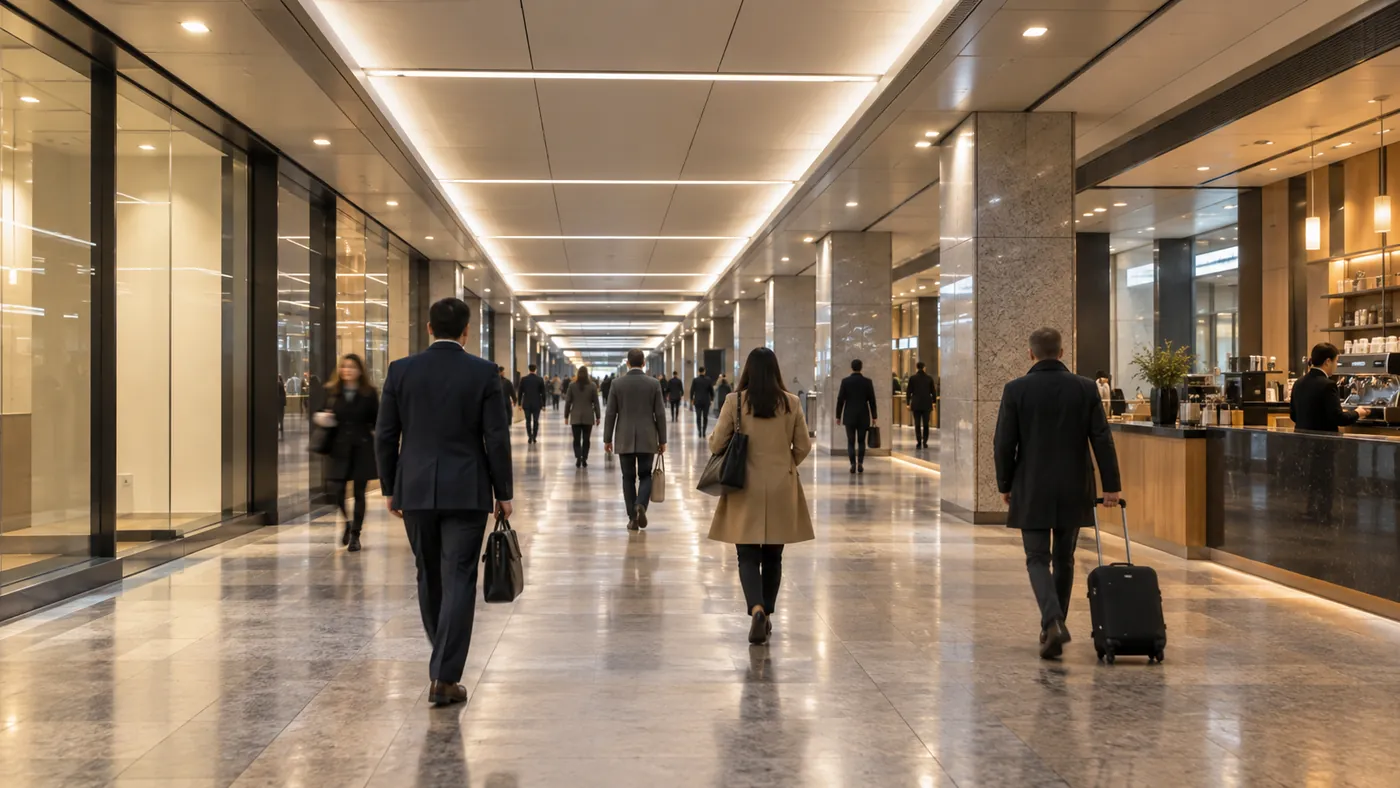
The PATH. The City of Toronto describes the PATH as a mostly underground pedestrian network spanning more than 30 kilometres beneath downtown, carrying more than 200,000 commuters on a business day and connecting Union Station to office towers across the core. If your building is on it, you can walk from the train to your lift without going outside. In January that is a significant advantage.
The street. Bay Street runs north from Front, and walking it is straightforward and often quicker than the PATH for a building you can see. Allow roughly ten to fifteen minutes to reach the northern end of the district.
Line 1. Union station is on the subway's Yonge–University line. For an address near Queen or Adelaide, one or two stops saves a walk. Tap a contactless card or a card in a phone wallet; a two-hour transfer applies automatically.
Two caveats on the PATH. It runs through many separate privately owned buildings, so hours vary by section and connections are quieter at evenings and weekends. And general mapping apps tend to route you along the street above; the City's own map is more reliable underground.
For meetings that continue west along King Street and into the Entertainment District, our page on chauffeur service around King West and the Financial District covers that stretch specifically.
By RoadTaxis and airport limousines.
Licensed taxis and airport limousines queue at designated arrivals-level stands rather than inside the terminal. They charge posted flat rates to Toronto destinations rather than metered fares, which removes the traffic risk from the price if not from the journey.
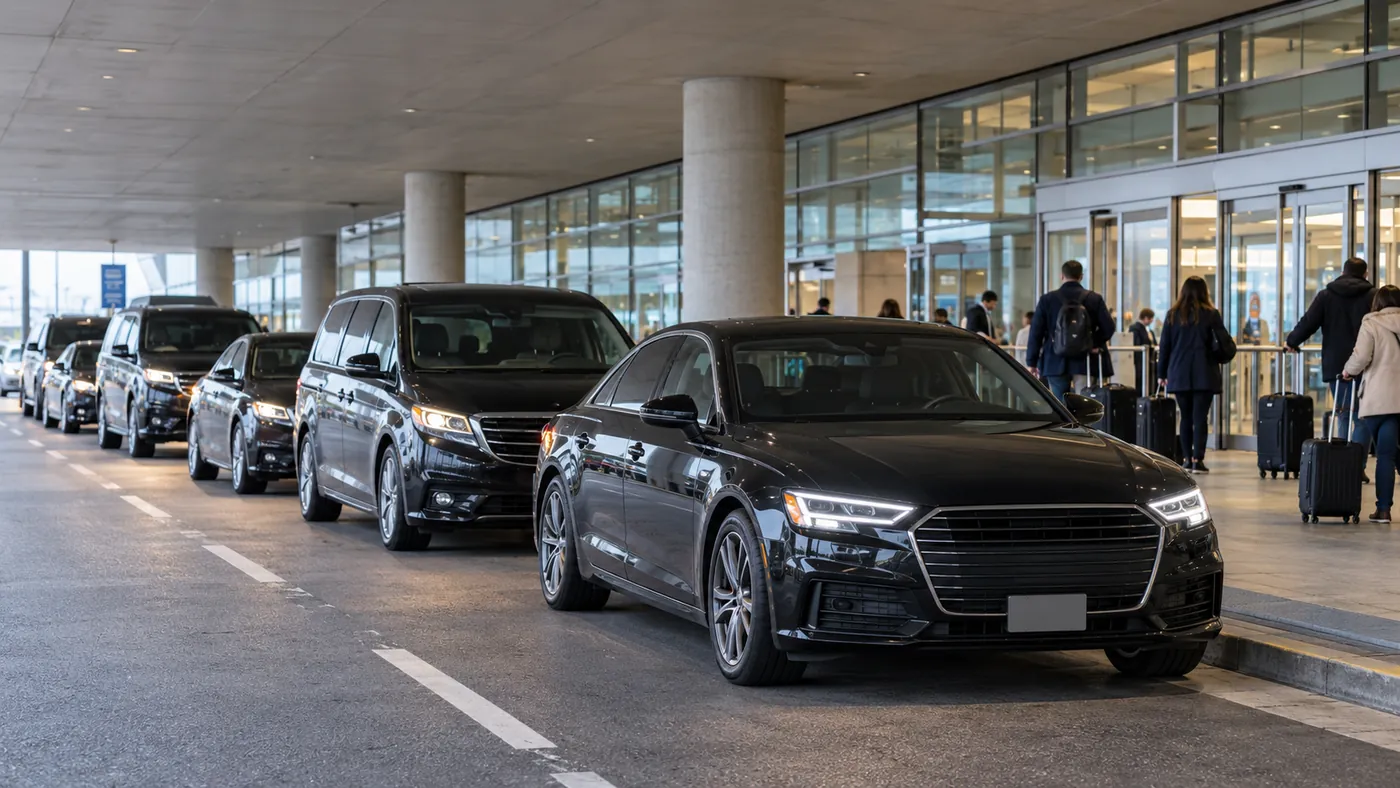
Rates are displayed at the stands and published by the airport, which is the right place to check before travelling since they change. The practical trade-offs: no booking needed and a vehicle almost always waiting, against a journey time that depends entirely on the highway, and a queue of your own at peak arrival times.
Ride-share.
Ride-share vehicles collect from designated pickup zones, which are separate from the taxi and limousine stands and involve a short walk from arrivals. You match with a driver after you land, as anywhere else.
It suits a traveller with one or two bags arriving outside the busiest periods. Two things to weigh: pricing moves with demand, so a wave of arrivals or bad weather can change the number considerably between checking and booking; and at busy times the zone itself becomes a queue.
Pre-arranged private transfer.
Booked before you fly, with the vehicle assigned to your flight. The chauffeur meets you at the terminal, handles the luggage and drives you to the building rather than the station.
What it changes, specifically:
- It ends at your address, which removes the last-mile question entirely.
- The arrival is monitored, so a delayed flight moves the pickup rather than forfeiting it.
- The bags stay in the vehicle if you are going straight to a meeting.
- The price is agreed in advance from your actual addresses, rather than moving with demand.
Pre-arranged vehicles meet passengers at a different door from the taxi stands and the ride-share zones, so it is worth knowing where each kind of vehicle meets you at Terminal 1 and Terminal 3 before you land. Service details are on the Pearson airport transfers page.
PlanningA realistic time budget.
The number that matters is not the journey time. It is the gap between your scheduled landing and the moment you are seated in a meeting. That has five components, and most travellers account for one of them.
| Stage | Domestic arrival | International arrival |
|---|---|---|
| Deplaning and walking to the hall | Included in most estimates | Often a long walk at Terminal 1 |
| Border clearance | Not applicable | Highly variable; the biggest unknown |
| Checked baggage | Adds time if you checked a bag | Adds time, after clearance |
| The journey | About 28 minutes by train, or a road journey | Same |
| The last mile | A few minutes to about 15 | Same |
A defensible planning figure. For an international arrival with a fixed meeting, allow two and a half to three hours from scheduled landing. For a domestic arrival with hand luggage only, considerably less. Border clearance is the variable that breaks schedules, and our guide to how long customs actually takes sets out what drives it.
If the meeting genuinely cannot move, the honest advice is to fly in the night before. No ground transport arrangement compensates for a queue at the border.
The luggage problem.
Rarely discussed and frequently decisive. You cannot take a suitcase into a boardroom, and a meeting scheduled before check-in time leaves you carrying it.
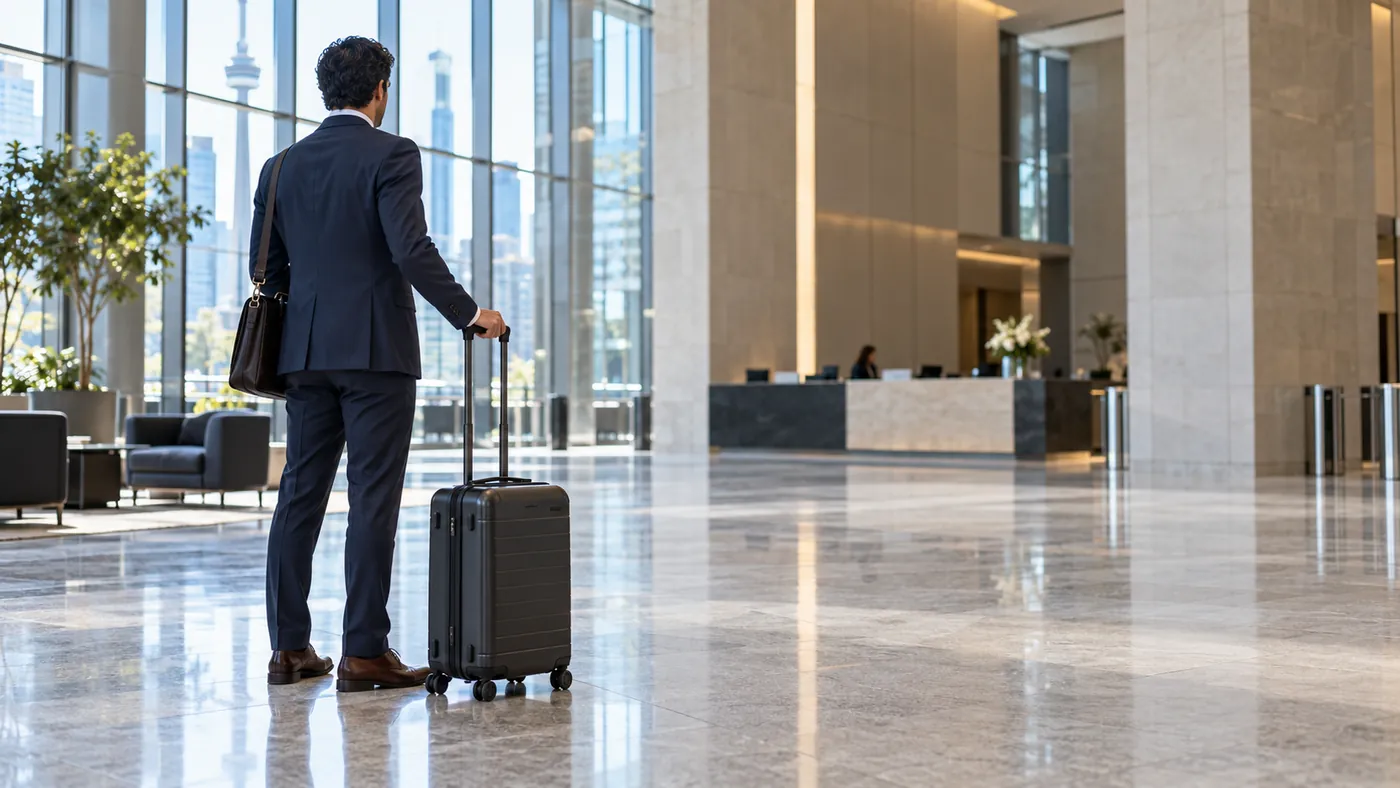
Three workable answers:
- Hotel first. Most hotels will hold luggage before check-in. It costs a detour, which is usually fine if the hotel is downtown.
- Storage at Union Station. BagsAway operates luggage storage within the SkyWalk, close to the UP Express platform. Convenient if you are arriving by train and your meeting is nearby.
- Keep them in the vehicle. With a pre-arranged transfer, the bags stay with the car between stops. For a day with a meeting, lunch and an onward move, this removes the problem entirely.
Vehicle size matters here more than most travellers expect, particularly for two or three colleagues arriving together with checked bags. Our fleet page sets out matching the vehicle to your luggage.
When the flight lands late.
Each route handles a delay differently, and the difference is worth knowing before it happens.
- UP Express. Trains every 15 minutes, so a delay costs you the delay plus a short wait. The most forgiving option.
- Taxi or airport limousine. The stand is there whenever you emerge. Also forgiving, though the queue grows when several flights land together.
- Ride-share. You book when you are ready, but a wave of delayed arrivals pushes both the wait and the price.
- Pre-arranged transfer. The flight is monitored and the pickup moves with the actual landing. Obsidian Ride includes complimentary wait time on airport pickups.
The one arrangement that does not survive a delay well is a vehicle booked for a fixed clock time with no flight number attached. Always give the flight number, whoever you book with.
Six mistakes.
- Assuming the UP Express serves both terminals. It is Terminal 1 only.
- Treating Union Station as the destination. It is the southern edge of the district.
- Not checking whether the building is on the PATH. It changes the last mile completely in winter.
- Budgeting only the journey time. Border clearance and baggage are the real variables.
- Arriving at a meeting with a suitcase. Decide where the bags go before you fly.
- Booking a car for a clock time instead of a flight. A delay then costs you the vehicle.
Executive arrivals.
For a single traveller with a cabin bag and an office near Union Station, the train is the right answer and this guide has said so. A private transfer earns its place in four specific situations on this route.
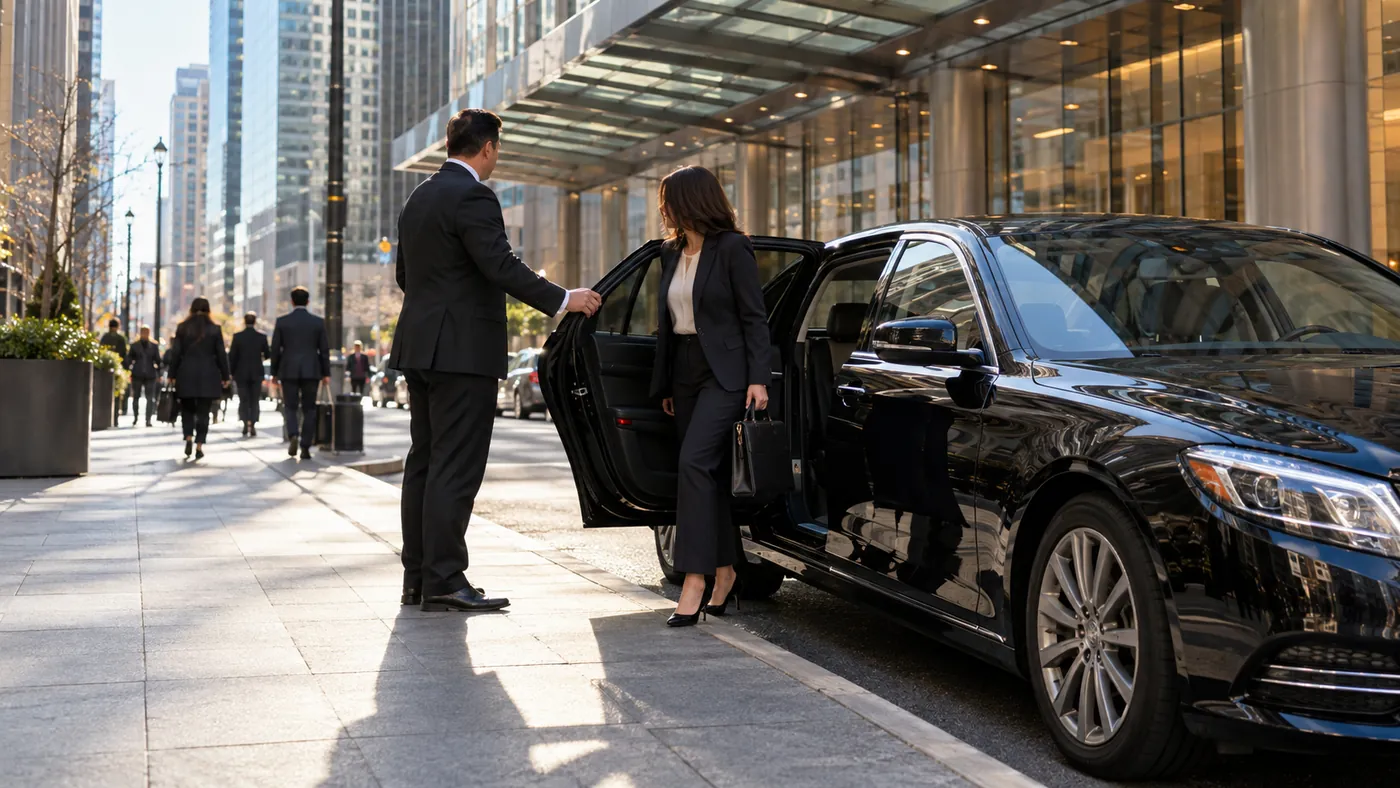
- A fixed meeting time. The arrival is monitored, the vehicle adjusts, and the journey ends at the tower rather than at a station several blocks away.
- Luggage, or colleagues. Two or three people arriving together with checked bags is where the train stops being convenient.
- An address away from the PATH, or a first meeting outside the core.
- Early or late arrivals, when a walk through an unfamiliar downtown with luggage is less appealing.
Obsidian Ride operates 24/7 dispatch with real-time flight tracking, and prices are agreed from your actual addresses before the trip rather than moving with demand. Organisations booking regularly can run arrivals through corporate travel accounts, with consolidated billing and a single point of contact for scheduling.
From the gate to the boardroom door.
Add your flight number and the building address, and the pickup follows the actual landing rather than the schedule.
Pearson to Financial District: frequently asked questions.
How do you get from Pearson to the Financial District?
Four practical options: the UP Express train from Terminal 1 to Union Station, a licensed taxi or airport limousine from the arrivals-level stand, a ride-share from the designated pickup zone, or a pre-arranged private transfer that meets you inside the terminal. The train is fastest for light travellers; the others go door to door.
How long does the UP Express take from Pearson to Union Station?
About 28 minutes, with trains every 15 minutes. That is the rail journey only. Add the walk to the platform at Terminal 1, the Terminal Link ride if you land at Terminal 3, and the walk from Union Station to your building, which can add another ten to fifteen minutes.
Does the UP Express serve Terminal 3?
No. The UP Express station is at Terminal 1 only. Passengers arriving at Terminal 3 take the free Terminal Link train, which runs around the clock between Terminal 1, Terminal 3 and Viscount Station, then walk to the UP Express platform. Build that connection into your timing.
Is Union Station in the Financial District?
It sits at the southern edge of it. The district runs north from Front Street toward Queen Street along and around Bay Street, so some towers are a few minutes from Union and others are a fifteen-minute walk. Check where your building sits before assuming the train drops you at the door.
Can you walk from Union Station to Bay Street offices indoors?
Often, yes. The PATH is a mostly underground pedestrian network spanning more than 30 kilometres beneath downtown Toronto, connecting Union Station to many office towers, and it carries more than 200,000 commuters on a business day. Check whether your building is on the network before planning a February arrival.
How much is a taxi from Pearson to downtown Toronto?
Licensed taxis and airport limousines charge posted flat rates to Toronto destinations rather than metered fares, and the rates are displayed at the stands. Toronto Pearson publishes current rate information, which is the right place to check before you travel, since fares change.
Where do you catch a taxi or limousine at Pearson?
At designated arrivals-level stands, not inside the terminal building. Licensed taxis and airport limousines queue at specific doors in each terminal. Ride-share operates from separate designated pickup zones, and pre-arranged private vehicles meet passengers at a different door again.
How much time should you allow from landing to a downtown meeting?
More than most people do. Budget for deplaning, border clearance if you are arriving internationally, baggage, the journey itself and the last mile to your building. For an international arrival with a fixed meeting, two and a half to three hours from scheduled landing is a defensible planning figure.
What do you do with luggage if you go straight to a meeting?
Three options: drop bags at your hotel first, use the luggage storage in Union Station's SkyWalk near the UP Express platform, or keep them in a pre-arranged vehicle that waits between stops. Arriving at a boardroom with a suitcase is the outcome to plan around.
What happens if the flight lands late?
With the UP Express, trains run every 15 minutes, so a delay costs you the delay plus a short wait. With a pre-arranged transfer, the arrival is monitored and the pickup moves with the actual landing. With a ride-share or taxi, you simply join the queue whenever you emerge.
Is a private transfer worth it for a business arrival?
It depends on the trip. For a traveller with a cabin bag and a meeting near Union Station, the UP Express is faster and cheaper. A private transfer is the better choice for luggage, a group, a fixed meeting time, an address away from the PATH, or a late-night arrival.