
Lost Luggage at Pearson Airport: What to Do, in Order.
If your bag did not come off the belt, the most important thing is to file a report before you leave the airport. This guide sets out the sequence, the extra customs step that applies to international arrivals, and the three separate deadlines that decide what you can claim under Canadian rules.
The belt slows, then stops. A few unclaimed cases circle past for the third time, and none of them is yours. It is a genuinely unpleasant moment, and the instinct to walk out and sort it later is the one thing that makes everything harder.
Almost every part of the process that follows depends on a report filed at the airport, with a reference number you take away with you. Do that, and the rest is administration. Skip it, and you spend the next fortnight proving something that would have taken ten minutes at the desk.
If you have lost luggage at Pearson Airport, report it to your airline before leaving the terminal and leave with a written file reference number. Airlines, not the airport, are responsible for tracing and delivering bags. On an international arrival you will also complete a customs form so the bag can be cleared when it arrives.
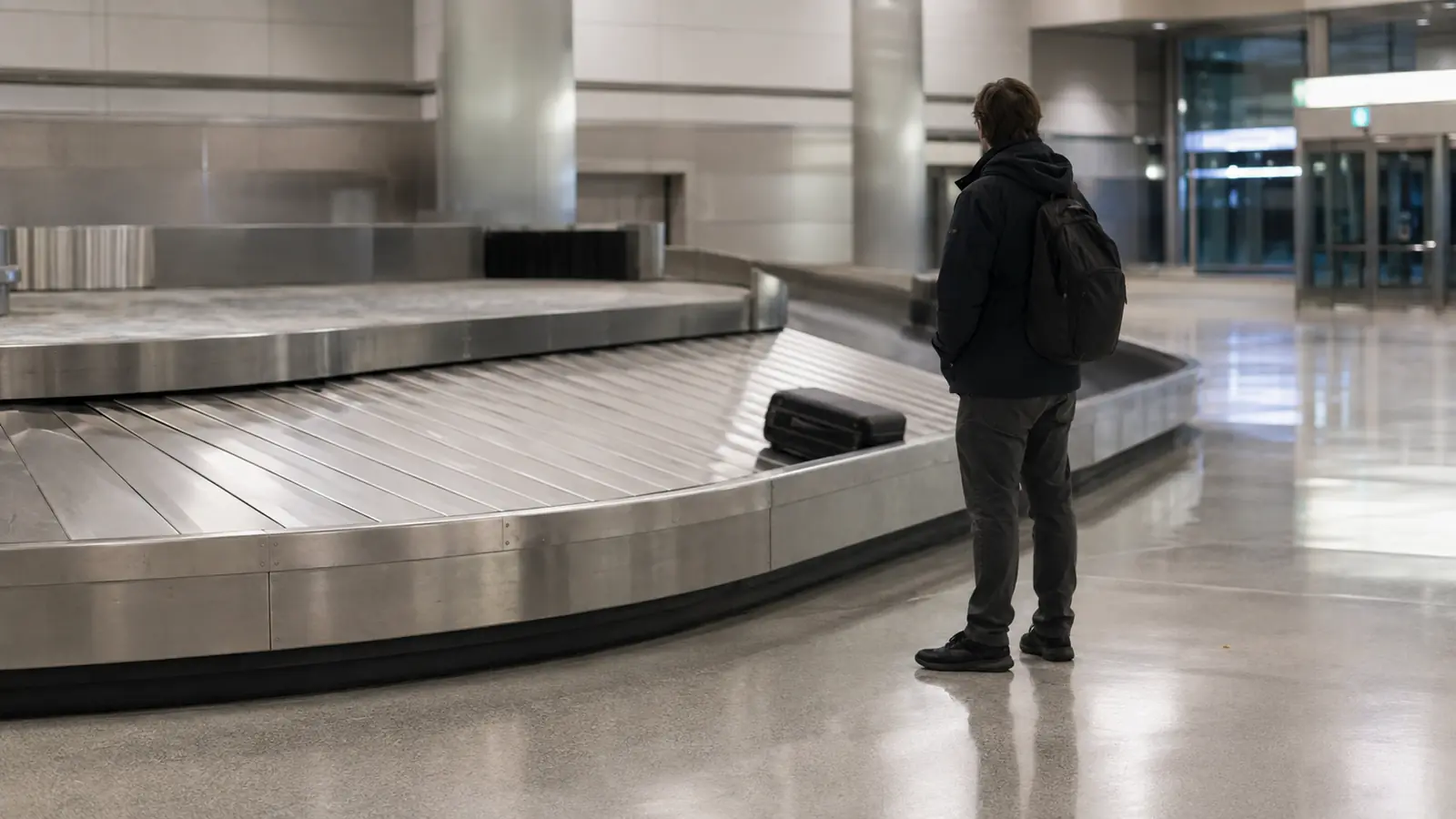
The first thirty minutes.
Work through this in order, at the airport, before you go anywhere.
- Check the right carousel. Display screens list the carousel by flight number, and Pearson's flight arrival guide shows baggage status and pickup location for your specific flight. Bags occasionally come out on a neighbouring belt.
- Look at the oversized area. Sports equipment, instruments, pushchairs and anything unusually shaped often bypass the carousel entirely.
- Find your airline's baggage desk. It sits inside the arrivals area, near the carousels. Grab a free baggage cart on the way; they are provided at no charge, courtesy of CIBC.
- File the report in person. Toronto Pearson's advice is explicit: complete a lost baggage report before leaving the airport.
- Describe the bag properly. Colour, brand, hard or soft shell, wheels, distinguishing marks, ribbons, stickers. If you have a photo on your phone, show it.
- Give a Toronto delivery address and a phone number that works here. A home address abroad is no use for a bag that turns up tomorrow at Pearson.
- Ask three questions. What is my file reference number? Do you deliver, and to where? Who do I contact, and how?
- Keep your documents. Bag tag stub, boarding pass and the report. Photograph all three before you leave the desk.
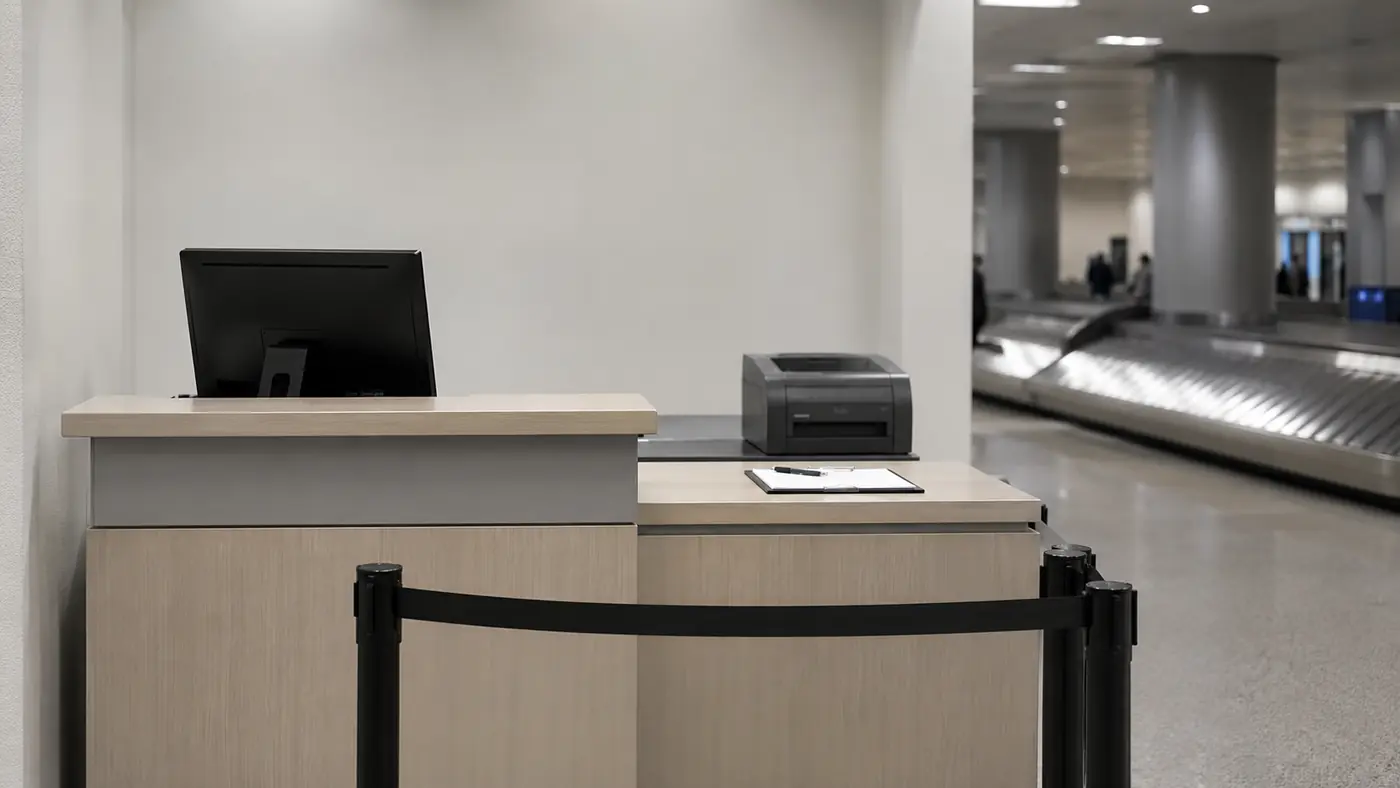
If you have already left the airport, contact your airline immediately rather than returning. The arrivals baggage hall is a controlled area and you will not simply be able to walk back in. Most airlines accept a report by phone or through an online form, though filing at the desk remains the cleaner route.
Who is actually responsible.
This is the most common misunderstanding, and it wastes a great deal of people's time.
Toronto Pearson states that airlines are responsible for handling and delivering bags, and directs travellers to contact the airline if luggage is lost, delayed or damaged. The airport also confirms that it does not have access to your checked baggage information at all.
So the airport cannot look your bag up, cannot tell you where it is, and cannot compensate you. Every thread of this leads back to the carrier whose name is on the tag. The one exception is a bag left behind inside the terminal, covered further down, which the airport does handle itself.
The file reference number.
When you file at the desk, the airline opens a record and issues a reference. Depending on the carrier it may be called a file reference number, a property irregularity report or a baggage claim number. It is usually a short alphanumeric code.

That code is the spine of everything that follows. It is what the tracking page asks for, what the claims team asks for, and what a regulator will ask for if the matter escalates. Photograph it, email it to yourself, and do not rely on a paper slip in a coat pocket at the end of a long journey.
International ArrivalsThe customs step almost nobody mentions.
If you arrived from outside Canada, a missing bag is not only an airline matter. It is also a border matter, because goods you acquired abroad are still being imported even though they are not with you.
The Canada Border Services Agency uses Form A23, a Delayed Baggage Report, for exactly this situation. It is collected under the Customs Act to determine the admissibility and the duty and tax treatment of the goods in your missing bag. Completing it authorises the carrier to open your baggage on your behalf for customs examination when it turns up.
Two details are worth knowing. The form asks whether the missing bags contain gifts for residents of Canada exceeding CAD$60 per item, or any other goods being left in Canada. And it states directly that failure to complete it may result in punitive action including seizure of your goods.
None of that is a reason for alarm. It is a reason to complete the form at the airport rather than treating the airline report as the only paperwork that matters. Your obligation to declare everything you acquired abroad does not pause because your suitcase is in another country. If you want a sense of how long this part of the arrivals process runs, our guide to how long clearing customs actually takes covers the variables.
Tracking your bag.
Once a report exists, most airlines offer an online tracker keyed to your reference number. What it shows varies considerably. Some display a live location and a routing plan; others show little more than a status word that does not change for two days.
A few practical notes:
- Most delayed bags are simply on a later flight. If the airline tells you which one, you can check the flight your bag was routed on yourself rather than waiting for an update.
- An electronic tracker of your own helps but proves little. A tracking tag can tell you the bag is still in Frankfurt, which is useful to relay, but airlines act on their own systems.
- Chase in writing. Phone calls leave no record. Email, or the airline's web form, creates the paper trail that matters later.
- Update the delivery address if you move. Travellers who file at the airport and then change hotels are a common source of failed deliveries.
Delayed, lost or damaged.
These three words carry different rules in Canada, which is why guidance that treats them as interchangeable is unhelpful.
| Status | What it means | Governed by | Baggage fee refund |
|---|---|---|---|
| Delayed | The bag has not arrived but is not yet considered lost | Your airline's tariff, which is expected to be consistent with the Montreal Convention | As set out in the airline's tariff |
| Lost | The airline admits the loss, or the bag has been delayed more than 21 days | Montreal Convention rules, applied to domestic flights by the Air Passenger Protection Regulations | Yes — airlines must refund baggage fees |
| Damaged | The bag arrives but is damaged | Same rules as lost baggage | Yes — airlines must refund baggage fees |
The 21-day threshold is the one to remember. Baggage delayed for 21 days is considered lost, and at that point you should submit a claim to the airline as soon as possible rather than continuing to wait.
What you can claim while you wait.
If you are in Toronto without your clothes, you can generally claim reasonable and necessary interim expenses. The important qualifier is that for delayed baggage this is governed by your airline's tariff rather than by a fixed regulation, so the terms differ between carriers.

Some ground rules that hold across most tariffs:
- Keep every receipt. No receipt, no claim. Photograph them as you go.
- Buy sensibly. Replacing a work shirt is reasonable. Replacing a wardrobe is not, and a claims team will say so.
- Ask the desk what the airline covers before you spend. Some issue an immediate kit or a set allowance.
- Remember it counts against the cap. Interim expenses come out of the same overall liability limit, so heavy spending now reduces what remains if the bag is never found.
- Submit in writing, promptly. Delayed baggage claims should go to the airline as soon as possible, and no later than the limit in your ticket's terms and conditions.
If the airline does not deliver and you have to return to Pearson to collect the bag yourself, an hourly booking for the return trip is one way to handle it without leaving a car in a garage for the afternoon.
CompensationThe liability limit, and why sources disagree.
Here is where most articles on this subject state a confident figure. The honest position is more useful.
Airline liability for baggage is capped in Special Drawing Rights, an International Monetary Fund unit of account, and the cap is reviewed periodically by the International Civil Aviation Organization for inflation.
The Canadian Transportation Agency's guide currently states a maximum of 1,288 SDR per passenger, roughly CAD$2,350 subject to exchange rates. Air Canada's published conditions of carriage, by contrast, state a limit of 1,519 SDR. Both are legitimate sources, and the gap reflects a review of the limits that airlines have applied in their tariffs sooner than the guidance text was rewritten.
What to do with that. Treat the figure as somewhere in that range, check your own airline's tariff for the number that governs your ticket, and do not build expectations around a precise amount. The cap matters far less than most people assume, because it is a ceiling on proven losses rather than a payout. Almost nobody reaches it.
Two further mechanisms are worth knowing. If your baggage is worth more than the limit, you may ask the airline before travelling for a special declaration of interest, sometimes called excess valuation. If the airline agrees, it becomes liable up to the declared sum, and it may charge a fee for this. Separately, when baggage is lost or damaged, airlines must refund optional baggage fees you paid, which covers standard, extra and oversized baggage charges. That refund does not apply to an allowance included in your fare.
Claim deadlines.
Three separate clocks run, and missing one can end a claim that was otherwise sound.
| Situation | Deadline | Form |
|---|---|---|
| Damaged baggage | Within 7 days of receiving the bag | In writing to the airline |
| Delayed baggage | As soon as possible, and no later than the limit in your ticket's terms | In writing to the airline |
| Delay becomes loss | At 21 days of delay | Submit a claim as soon as possible |
| Court action | 2 years, for lost or damaged baggage | Legal proceedings |
The seven-day damage deadline is the one people miss, because a damaged bag feels less urgent than a missing one and often gets noticed properly only after unpacking.
Damaged baggage.
Inspect the bag before you leave the carousel if you can. Wheels, handles, zips, frames and any tear or crack in a hard shell.
- Photograph the damage at the airport, with the tag still attached, before anything is repacked or removed.
- Report at the desk while you are there. Damage noticed at home is harder to attribute.
- Complain in writing within seven days of receiving the bag, whatever else you were told verbally.
- Ask about the fee refund. If the bag is damaged, the airline must refund the optional baggage fees you paid.
- Keep the damaged bag until the claim resolves. A claims team may want to inspect or collect it.
Mobility aids.
A wheelchair or scooter is not ordinary baggage, and the obligations are stronger. Airlines are obligated, up to the point of undue hardship, to transport mobility aids and to repair, replace or provide reimbursement for one that is damaged, delayed or lost.
Airlines must not charge a fee to transport a mobility aid, and should not charge for a special declaration relating to one. The Canadian Transportation Agency also recommends that passengers with disabilities who use mobility aids consider completing a special declaration of interest when travelling internationally, given that the standard liability cap can fall well short of the replacement cost of a powered chair.
A bag left behind in the terminal.
Different problem, different process. If you set a bag down somewhere in the terminal and walked away, that is the airport's territory rather than the airline's.
Pearson's team uses the bag tag to work out where an abandoned bag needs to go. If there is no tag, they check whether a name or phone number has been written on the case. Failing that, they work with airline partners to upload a description of the bag and some of the items inside it, so the owner can be traced.
That last detail is a strong argument for writing your name and a mobile number somewhere inside the lid of every case you own. It is the difference between a bag that can be identified and one that cannot. If you are enquiring, knowing which terminal you landed in will save a conversation.
If the airline goes quiet.
Claims sometimes stall. The route is sequential, and skipping a step usually sends you back to the start.
- Put the claim to the airline in writing, with your file reference number, and keep a copy.
- Follow up in writing if you hear nothing, referencing your original date of contact.
- Escalate to the regulator. Airlines are required to tell passengers about their recourse options, including complaining to the Canadian Transportation Agency. Complaints go through the CTA's air passenger protection service.
- Court remains available within the two-year limit for lost or damaged baggage, though it is rarely proportionate for a suitcase.
Check your travel insurance and your credit card benefits in parallel. Baggage cover is common on both, deadlines are often shorter than the airline's, and a policy may pay out faster than a carrier.
Next TimeBefore your next flight.
- Photograph your packed bag and its contents before you close it.
- Put contact details inside as well as outside. External tags come off; an internal card does not.
- Carry one change of clothes and all medication in your carry-on, always.
- Remove old tags. Stale barcodes genuinely misroute bags.
- Keep receipts for expensive items you travel with, since a claim needs proof of value.
- Check whether your connection re-tags. Pearson notes that if a bag is not tagged through to your final destination, you must collect it and check it in again for the onward flight.
- Consider a tracking tag, which will not speed the airline up but will tell you whether the bag is even in the country.
Six mistakes that weaken a claim.
- Leaving the airport without filing. Everything afterwards is harder and slower.
- Contacting the airport instead of the airline. The airport has no access to your baggage information.
- Losing the reference number. It is the key to every subsequent step.
- Skipping the customs form on an international arrival. The form itself warns that this can lead to seizure.
- Waiting past seven days on damage. That deadline is short and it is enforced.
- Handling everything by phone. Without a written record, escalation becomes your word against theirs.
The knock-on effect on your ride.
There is one practical consequence worth planning for, and it is the only place a transfer service genuinely enters this story. Filing a baggage report is not quick. It happens after you have already cleared customs, the queue at the desk grows when a whole flight's bags are missing, and there is no way to predict in advance whether it will take fifteen minutes or ninety.

A walk-up taxi or a ride-share booked from the baggage hall handles this badly, because you are committing to a pickup before you know how long the desk will take. A pre-arranged transfer handles it better: with your flight number on the reservation, the arrival is monitored, and Obsidian Ride includes complimentary wait time on airport pickups.
Details are on the Pearson Airport chauffeur service page, and if you are unsure where to head once you finally get outside, our guide to where each vehicle type meets you covers both terminals.
Arrivals that wait for you.
Add your flight number to the reservation and the pickup follows your actual arrival, whether you walk out on time or spend an hour at the baggage desk first.
Lost luggage at Pearson Airport: frequently asked questions.
What should you do if your luggage doesn't arrive at Pearson?
Report it to your airline before you leave the airport. Toronto Pearson advises completing a lost baggage report at the terminal, where the airline representative will explain how to track the missing item. Keep your bag tags and boarding pass, and make sure you leave with a written file reference number.
Who is responsible for lost luggage at Pearson, the airport or the airline?
The airline. Toronto Pearson states plainly that airlines are responsible for handling and delivering bags, and that the airport does not have access to your checked baggage information. The exception is a bag left behind inside the terminal, which the airport's own team will attempt to trace using the tag.
How long before delayed baggage is officially considered lost?
Twenty-one days. Under the Air Passenger Protection Regulations, baggage delayed for 21 days is considered lost, and you should submit a claim to the airline as soon as that point is reached. Before then it is treated as delayed, which is governed by your airline's tariff rather than by a fixed regulation.
How much compensation can you get for lost baggage in Canada?
Compensation is capped rather than fixed, and you must prove your actual loss. The Canadian Transportation Agency's guide states a maximum of 1,288 Special Drawing Rights, roughly CAD$2,350. Some airlines now apply a higher limit of 1,519 SDR in their conditions of carriage, so check your airline's tariff for the figure that applies to you.
Do you need a customs form if your bag is delayed on an international arrival?
Usually yes. The Canada Border Services Agency uses Form A23, a Delayed Baggage Report, so that goods still in your missing bag can be assessed and examined when they arrive. Completing it authorises the carrier to open your baggage for customs examination on your behalf. The form warns that failing to complete it can lead to seizure.
Can you claim for things you buy while your bag is delayed?
Generally yes, for reasonable and necessary items, though the terms are set by your airline's tariff rather than by a fixed regulation. Keep every receipt, buy sensibly rather than extravagantly, and submit the claim in writing as soon as possible. Any reimbursement counts against the same overall liability limit.
What is the deadline to claim for damaged baggage in Canada?
Seven days. For domestic services, passengers must complain in writing to the airline within seven days of the date they received the baggage. Miss it and your claim may not be considered. Separately, there is a two-year limit for any court action to claim damages for lost or damaged baggage.
Will the airline deliver my delayed bag to me in Toronto?
Most will, but it is set by each airline's tariff rather than by regulation, so ask at the baggage desk rather than assuming. Air Canada's published conditions of carriage state it will do its best to deliver a delayed bag within 24 hours. Confirm the delivery address and a contact number before you leave the terminal.
What if I left a bag behind in the terminal rather than it going missing?
That is handled by the airport rather than the airline. Toronto Pearson's team uses the bag tag to determine where it needs to go. For an untagged bag, they check whether a name or phone number is written on the case, and otherwise work with airline partners to log a description of the bag and its contents to help trace the owner.
What can you do if the airline doesn't respond to your claim?
Escalate to the Canadian Transportation Agency. Airlines are required to tell passengers about their recourse options, including the ability to complain to the CTA. Submit your complaint to the airline in writing first and keep the correspondence, since the CTA will expect to see that you raised it with the carrier.
Should I still book an airport transfer if my bag might be delayed?
A pre-arranged transfer handles this better than a walk-up option, because filing a baggage report adds an unpredictable stretch after you clear customs. With your flight number on the reservation, the arrival is monitored and the pickup shifts with it. Obsidian Ride includes complimentary wait time on airport pickups.